Lifecycle marketers often know exactly what they want the customer experience to look like. That comes through in conversations about personalization. They can explain where the current experience falls short, and in some cases they’ve already collected the data and tested an idea that looks promising.
Then the conversation turns to what it would take to actually do it, and that’s where it changes. There are more messages to create, more branches to build, another team to involve, or a system that needs to connect to something it doesn’t connect to today. They know what they want to do. The execution is where things get tangled.
The vision is already there
In one conversation, a marketer described wanting his team to spend more time talking to customers, coming up with ideas, and developing creative. He wanted AI to help with the repeated work of testing those ideas and deciding which messages to show to which people.
He was specific about the outcome. He wanted to try different creative, learn from the response, and adapt the communication without having to manually set up every experiment. His team was already stretched. As he put it:
“We’re already pretty much at capacity, and we’re not even close to hitting all the things we want to.”
In another conversation, a brand was already personalizing onboarding based on what it knew about its customers. It wanted to go further, using more information about why people used the product and how it fit into their lives. The marketer could describe why those details mattered: messaging that makes sense for one person’s routine might make very little sense for someone else’s.
But each additional detail introduced more combinations to manage. Different reasons for using the product, different circumstances, different messages. At one point, they said:
“We have this data. We just can’t execute on it.”
That is a much more specific problem than needing to collect more information. The team had information it believed should change the customer experience. Making it change the experience required branching logic and content that were becoming difficult to manage.
From a customer’s side, the expectation can sound simple: if I’ve told you what I’m interested in, use that information when you talk to me. From the team’s side, doing that consistently can involve several systems and a lot of ongoing work.
The questions behind the idea
The questions that come up after a team understands what a product can do are often the most revealing. Who creates the messages for all those scenarios? Can we use the creative we already have? Does this require engineering? How do we know what was sent to someone? What happens when we need to change it? Those questions tell you what has to happen for a new capability to be useful.
One lifecycle leader asked how a new creative workflow would fit with the work her team was already doing. She wanted to avoid developing the same content twice. Another described testing ideas quickly, then having to figure out how to scale the ones that worked without taking on too much maintenance. Later in that conversation, she put it plainly:
“We have tons of ideas. Our bottleneck is execution.”
Four places execution gets stuck
“Execution” covers several different problems. A team might be waiting on data, struggling to produce enough creative, or trying to maintain too many combinations of conditions. Each can leave a good idea stuck, but each needs a different kind of help. A useful starting point is to describe the experience you want the customer to have, then identify exactly where it gets stuck.
Imagine, for example, a subscription app trying to improve onboarding. Two people signed up for different reasons, but they receive the same introductory messages. The team captured their goals during signup and wants to use that information to help each person discover a relevant feature. The desired experience is clear enough, but there are several reasons it might not be happening.
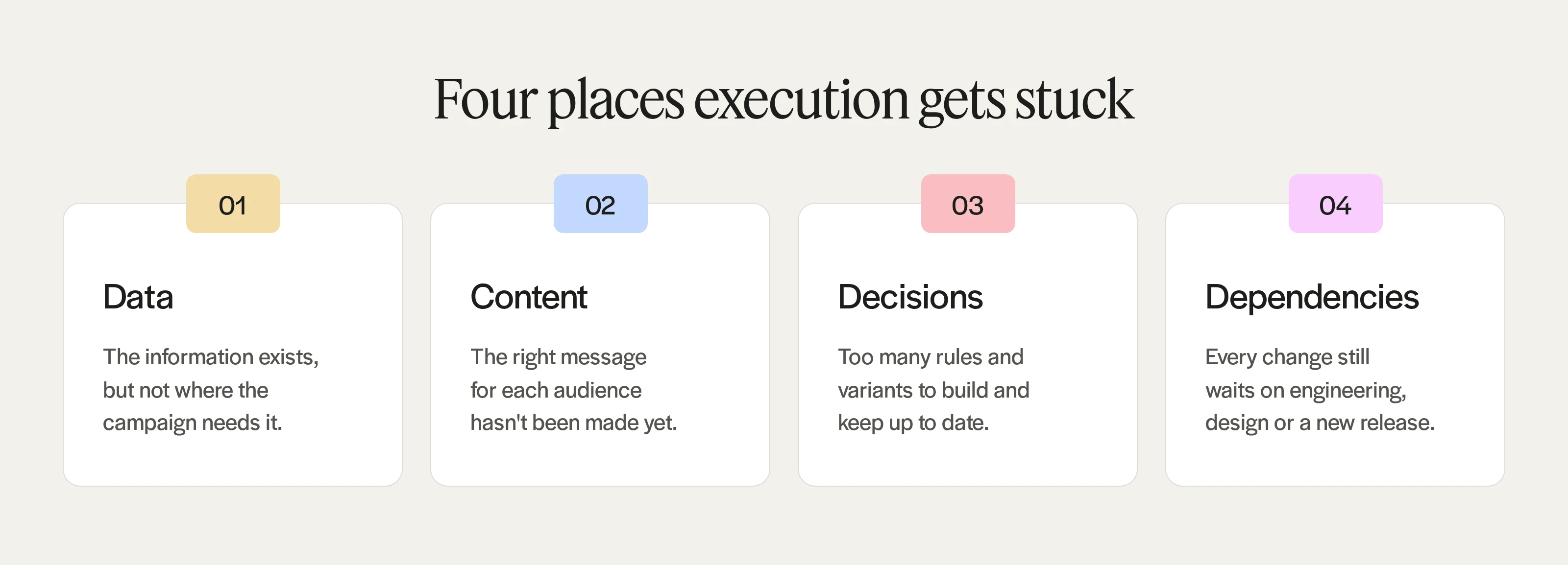
1. The information isn’t available where it’s needed
The signup answers might exist in a database without reaching the messaging platform. The next step is to establish how those answers get there and stay up to date.
2. The team doesn’t have suitable content
The information arrives, but every customer still gets the same message because that’s the only approved message available. Here, the work is creating and approving useful alternatives. More precise targeting won’t supply the missing content.
3. The decisions are becoming too complicated to maintain
The team has the information and the messages, but now needs to combine a person’s goal with what they’ve done, what they’ve already received, and whether they should hear from the brand again. This is the problem behind some of those conversations about branching. The question is how to make those choices manageable and keep track of what happens.
4. The work depends on another team
A marketer might need an engineer to make a change or someone to approve the copy. Make the dependency specific: what needs to change, who owns it, and whether a smaller version can go live sooner.
The customer sees the same generic onboarding in each case. Inside the company, the reason could be completely different. That distinction matters when evaluating a new tool or deciding what to build. A tool that produces more creative might be useful in the second situation and leave the first untouched. An easier journey builder could help with setup while still leaving someone responsible for maintaining all the combinations afterward.
It also makes the conversation about AI more concrete. Which part of this work would it take on? What would the team still need to provide, approve, or check? A convincing answer should connect to the task that’s holding the experience back.
Start with something you can ship
One marketer brought this back to a very immediate concern: he was interested in a more ambitious approach, but also needed help getting something live in the next couple of weeks. He still had work to ship in the meantime.
For the hypothetical onboarding example, a useful first test might simply be to use one stated customer goal to choose between two approved messages. That would let the team test whether using that information helps, before building a much larger set of variations.
One stated customer goal, two approved messages and one outcome to measure.
Decide what improvement you expect to see. In this example, that could mean more people using the relevant feature within a defined period. Compare against the existing experience where possible, and track the work required to run the test: creating the messages, making changes, checking the targeting, and fixing anything unexpected. When a team says an idea worked, what did it take to keep it working? An improvement that requires constant attention creates a different decision for a team that’s already stretched.
Make the next conversation specific
Before the next discussion about better personalization, try completing a more specific sentence:
“We want the customer to experience this, but this particular piece of work is preventing it.”
For our onboarding example: “We want people to discover the feature that matches the goal they gave us at signup, but those answers aren’t available in the system that sends their onboarding messages.” Now the team can identify who needs to be involved, what needs to change, and whether a new tool would help with that work.