A habit loop is the repeating cycle of trigger → action → reward that makes users return to an app automatically. Not because they decided to, but because opening the app became part of how they move through their day.
The apps with the highest retention aren’t just the most useful ones. They’re the ones engineered to be habitual. Understanding how to build that is now one of the most valuable skills in consumer product.
What Is a Habit Loop?
Charles Duhigg popularized the model in The Power of Habit (2012). Every habit has three elements working in sequence:
The Cue triggers the behavior, whether it’s a time of day, an emotion, or an event. The Routine is the behavior itself. The Reward is what the brain gets out of it, which determines whether the behavior gets encoded as a habit or forgotten.
In apps, this translates directly. The cue might be a push notification or a moment of boredom. The routine is a tap, a scroll, a log. The reward is what users feel afterward: progress, connection, information, or even a satisfying animation.

When all three elements align, the loop closes. And once it closes enough times, it stops requiring deliberate decision-making. It becomes automatic, which is exactly where every consumer app wants to live.
Habitual users and engaged users are not the same thing. Engaged users come back because they want to. Habitual users come back because it’s just what they do. Apps with habit-level usage retain users at 2–3x the rate of apps that rely on intentional re-engagement.
The Hook Model: Four Stages Built for Apps
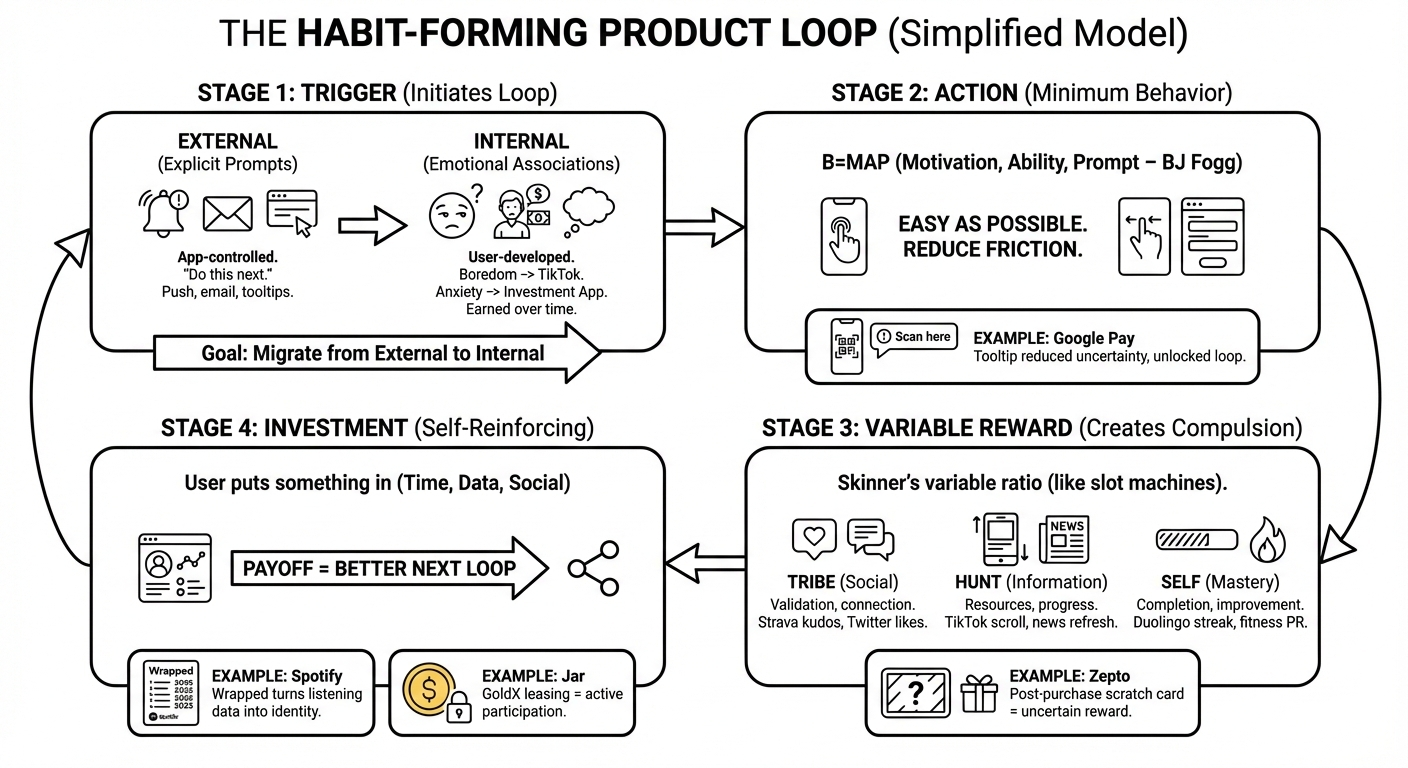
Nir Eyal’s Hook Model, introduced in Hooked (2014), extends the classic habit loop into four stages. Each maps directly to decisions product teams make every day.
Stage 1: Trigger
Triggers initiate the loop. Eyal divides them into two types.
External triggers are explicit prompts: push notifications, banners, email nudges, tooltips. These are the triggers your team controls directly.
Internal triggers are associations users develop between an emotional state and the app. Boredom triggers TikTok. Money anxiety triggers a finance app. A sense of incompleteness triggers Duolingo. These can’t be manufactured. They’re earned, over time, by consistently delivering value when external triggers fire.
The goal of every habit-forming app is to migrate users from external to internal triggers. External triggers require constant investment. Internal triggers are self-sustaining.
Stage 2: Action
The action is the minimum behavior that earns the reward. Eyal draws on BJ Fogg’s Behavior Model here: behavior happens when motivation, ability, and a prompt converge. If any one of these is missing, the behavior doesn’t happen.
The practical implication: the action must be as easy as possible. Every unnecessary tap, every non-required field, every unoptimized loading screen reduces ability and kills the loop.
Stage 3: Variable Reward
Predictable rewards create satisfaction. Variable rewards create compulsion. This goes back to B.F. Skinner’s variable ratio reinforcement schedules, the same mechanism behind slot machines and every social feed ever built.
Variable rewards in apps come in three forms:
Rewards of the Tribe are social validation and connection. Strava’s kudos, Twitter likes, Instagram comments. These are inherently variable because users never know how many they’ll get.
Rewards of the Hunt are information, resources, or discovery. The TikTok scroll. The pull-to-refresh. The portfolio check. The reward is the possibility of finding something valuable.
Rewards of the Self are mastery and completion. Duolingo’s streak, a fitness app’s personal record, a habit tracker’s completion ring.
Stage 4: Investment
This is the stage most apps skip, and it’s the one that makes the loop self-reinforcing.
Investment is when users put something into the product: time, data, content, preferences. The payoff comes later, when the product uses that input to deliver a more personalized experience, which becomes the trigger for the next loop.
Spotify’s Wrapped is the clearest example. Users invest a year of listening behavior. Wrapped turns that into a shareable identity statement. That payoff deepens emotional connection and resets the investment cycle.
What Most Apps Get Wrong
Triggering Before Earning the Right To
Sending a push notification to a user who hasn’t yet experienced your core value is one of the fastest ways to get uninstalled. Triggers only work once users associate your app with a reward. If that association doesn’t exist, an external trigger is noise.
The rule: don’t ask for notification permissions or fire re-engagement nudges until users have completed at least one successful loop. Earn the trigger first.
Too Much Friction on the Core Action
Most product teams can name their core action. Fewer can accurately count the taps it takes to complete from a cold app open. Fewer still have watched a real user attempt it for the first time.
Friction accumulates invisibly: an extra confirmation dialog, a loading screen before a key page, a form asking for non-essential information. Each is a leak in the loop where an emerging habit can drain away.
Linear Rewards
If your app shows users the same dashboard every session, the reward is fully predictable. Predictable rewards satisfy. They don’t compel return visits.
The fix isn’t arbitrary randomness. It’s finding the naturally variable elements in your product and surfacing them. A finance app can show a different spending insight each session. A fitness app can surface a new peer comparison. An e-commerce app can lead with a personalized deal.
No Investment Ask
If users don’t put anything into your app, they have no reason to return for the payoff. The product hasn’t become “theirs” yet.
Onboarding is the most critical investment moment, and most apps waste it. Collecting preferences and goals in the first session isn’t just about personalization. It creates psychological ownership. Users who have told your app what they care about have a reason to come back and see what it does with that information.
Measuring Whether Your Loop Is Working
Three metrics tell you whether a habit loop is healthy.
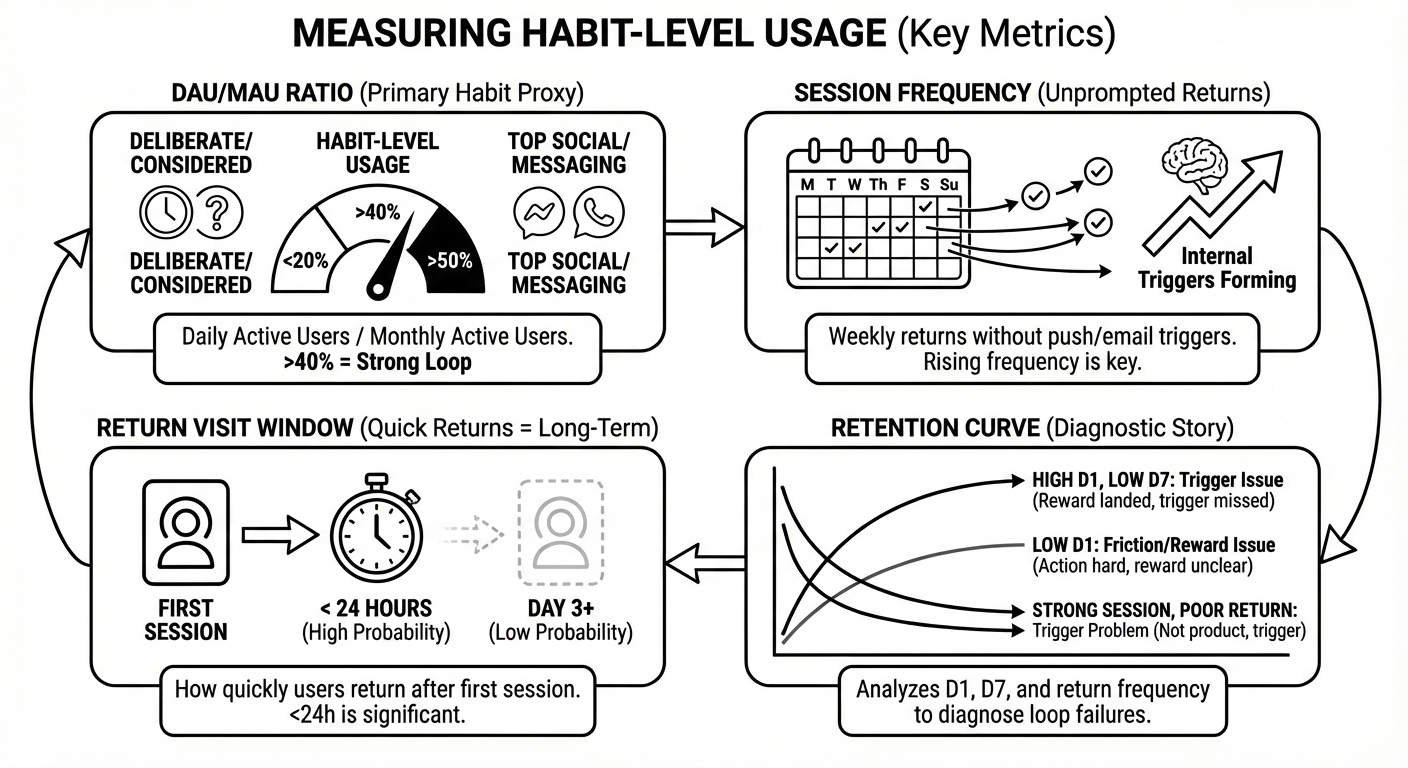
DAU/MAU Ratio is the primary proxy for habit-level usage. Consumer apps with strong loops typically exceed 40%. Top social and messaging apps exceed 50%. Below 20% signals that usage is deliberate and considered, not automatic.
Session Frequency measures how often users return unprompted per week, without being triggered by a push or email. Rising unprompted frequency is the clearest signal that internal triggers are forming.
Return Visit Window tracks how quickly users return after their first session. Users who return within 24 hours are significantly more likely to become long-term users. If someone hasn’t returned by day 3, the probability of forming a habit drops sharply.
Your retention curve tells a diagnostic story. High D1, low D7 means the reward landed once but the trigger for the second session wasn’t set up. Low D1 means the action had too much friction or the reward wasn’t felt in the first session. Strong session length with poor return frequency is usually a trigger problem, not a product problem.
Habit Loops vs. Dark Patterns
Habit loops and manipulative design share some mechanics. The difference is intent and alignment.
A loop that serves the user’s goals (helping them save more, learn faster, get fitter) is a product doing its job well. A pattern that exploits psychological vulnerabilities to drive behavior against the user’s own interests is manipulation.
In 2026, this distinction has regulatory weight. The EU’s Digital Services Act and FTC enforcement actions have made manipulative design an active legal risk. Eyal’s own framework offers a practical test: would users continue the behavior if they fully understood how the loop worked? Can they easily reduce or exit it? Ethical loops pass this test. And beyond the ethics, they’re better business. Habits built on genuine value are durable. Habits built on exploitation churn when users notice.
Habit Loop Examples
Duolingo
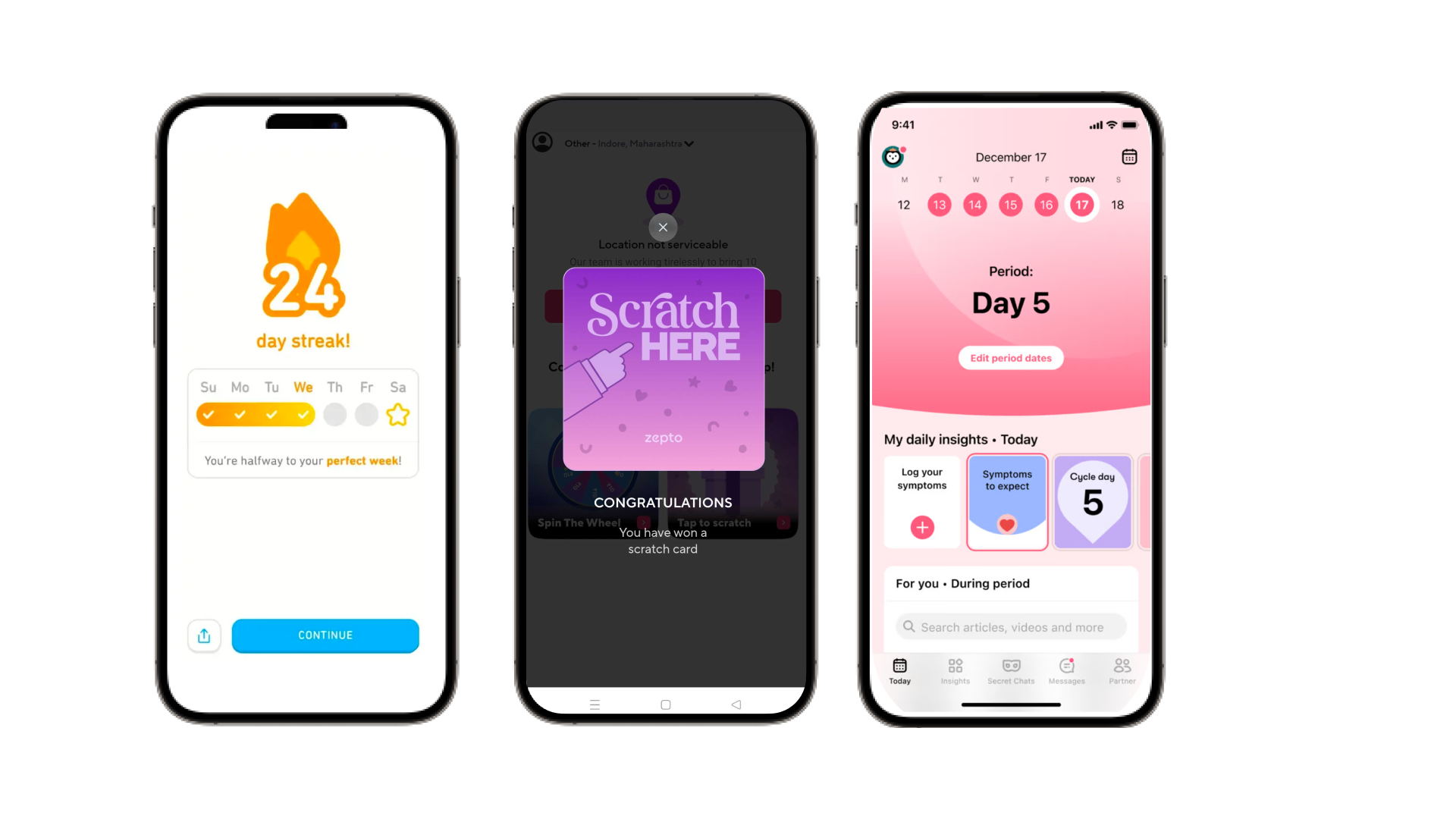
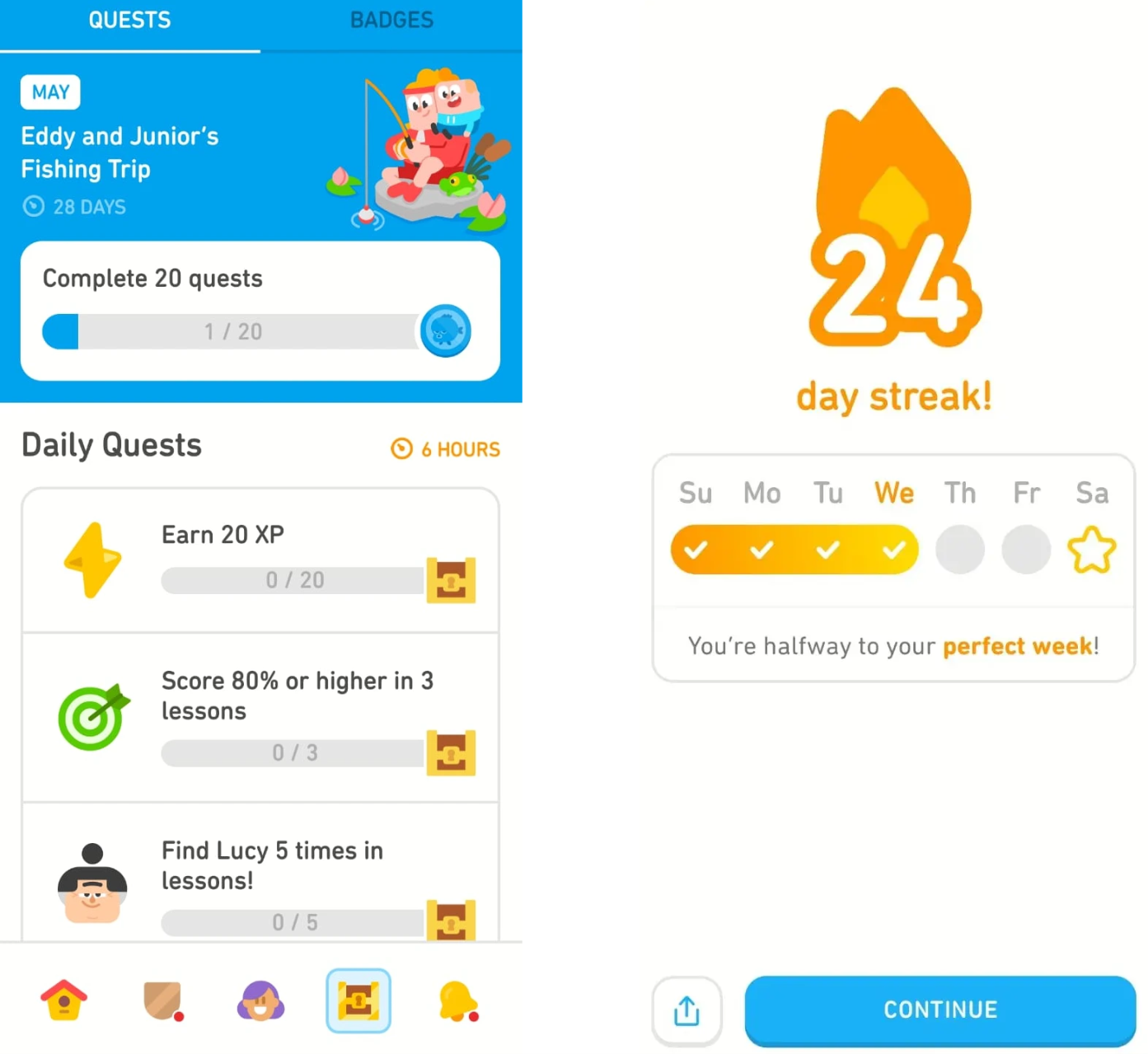
The trigger is the disappointed owl notification, an external cue anchored to not wanting to break the streak. The action is one lesson, designed to take under five minutes. The reward is streak preservation and league standing. The investment is the streak itself. Losing 60 days of progress is psychologically costly, and that cost is what keeps users coming back.
Flo Health
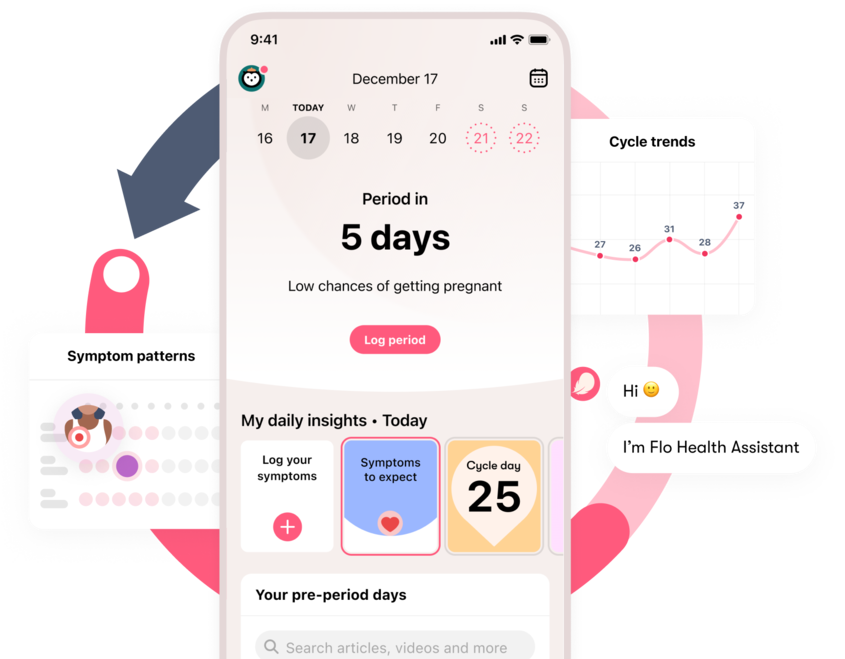
Cycle predictions create a reliable, personalized external trigger users trust. The action is logging symptoms, deliberately kept to two taps. The reward is personalized health insights that become more accurate the more you log. Each log makes the model smarter, raising both product value and switching cost.
Zepto
The post-purchase moment triggers the reward presentation. The action is a single tap to scratch a card. The reward is a variable discount or partner offer. The expectation of the scratch card becomes part of why users choose Zepto over a competitor.
.gif)
Zepto built and launched this experience using Plotline’s gamification features, without an engineering sprint.
Want to build habit loops like Zepto? Plotline gives product teams the tools to design and launch in-app triggers, variable reward mechanics, and personalized onboarding flows without touching code. Book a demo →
Frequently Asked Questions
Q. What is a habit loop in an app?
A. It’s the repeating cycle of trigger, action, and reward that causes users to return automatically. It’s based on Charles Duhigg’s model and applied to digital products through frameworks like Nir Eyal’s Hook Model.
Q. How does the Hook Model differ from the standard habit loop?
A. It adds a fourth stage, investment, where users put time, data, or content into a product. That input increases the product’s value over time and sets up the trigger for the next loop.
Q. How do I know if my app has a strong habit loop?
A. Look at your DAU/MAU ratio (target 40%+), session frequency (how often users return unprompted per week), and return visit window (ideally within 24 to 72 hours of the first session).
Q. Are habit loops the same as dark patterns?
A. No. Loops designed to serve the user’s goals are good product design. Dark patterns drive behavior against user interests. The test: would users continue the behavior if they fully understood how the loop worked?
Q. How long does it take for users to form an app habit?
A. Research from UCL (Lally et al., 2010) puts the range at 18 to 254 days, with a median around 66 days. For apps, the first 7 days are the most critical. Users who return consistently in the first week are significantly more likely to become long-term habitual users.