Off-app channels are being filtered by AI infrastructure. Push notification opt-in rates are falling. Email click-to-open rates sit below 7%. And the tools that powered growth for the last decade — Braze, MoEngage, CleverTap — were built for a world where these channels had full attention.
That world is ending.
A structural shift is happening in how consumer apps retain users. Three forces — Gmail’s AI Inbox, Apple Intelligence, and sheer notification volume — are simultaneously eroding the reach of off-app channels. This isn’t cyclical. It’s infrastructure being rebuilt to serve users who are overwhelmed.
The growth teams that win over the next five years won’t be the ones with better push copy. They’ll be the ones who build better experiences inside the app.
The three forces killing off-app reach
Force 1: Gmail’s AI Inbox
In January 2026, Google rolled out its AI-powered inbox to Gmail’s 3 billion users. The AI reads emails and surfaces what matters — without the user opening a single one. AI Overviews summarize threads. A one-click unsubscribe panel ranks brands by send frequency.
The result was counterintuitive: open rates went up after the rollout. But CTRs dropped. The “open” happened — the user just wasn’t there.
Meanwhile, unsubscribe rates jumped 2.75x in a single year once Gmail made it one click (MailerLite, 2025).
The platforms being built to reduce promotional noise are not a trend. They are infrastructure. Writing better subject lines is not the answer.
Force 2: Apple Intelligence
iOS 18 introduced a suite of AI features that fundamentally change how users interact with brand communications:
- AI-summarized push notifications on the lock screen
- Inbox categorization in Apple Mail: Primary / Transactions / Updates / Promotions
- Digest View collapsing brand emails into a single thread
- “Reduce Interruptions” focus mode that filters notifications by inferred importance
No mechanism exists for brands to influence the ranking. Your push notification competes with the user’s mom and their calendar — and the AI decides who wins.
Android push opt-in rates dropped from 85% to 67% in a single year. The overall average is now 61% (Batch, 2025).
Force 3: Volume killed attention
The average smartphone user receives 46 push notifications per day. 46% of users will disable notifications entirely if they receive just 2–5 messages in one week.
Email click-to-open rate sits at 6.81% — meaning fewer than 7% of people who “opened” the email actually engaged with its content.
The math is simple: more brands competing for the same off-app surface, fewer users paying attention, and now AI infrastructure actively filtering the noise. Off-app reach is declining structurally — not because growth teams are getting worse at it, but because the channel itself is degrading.
The retention curve is set in the first 7 days
The data makes a case that every growth team should sit with: the retention curve is set in the first 1–7 days. No push notification can fix it retroactively.

D30 retention benchmarks by vertical
| Vertical | D30 Retention | Key Insight |
|---|---|---|
| Fintech | ~11.6% | Activation is the primary failure point |
| Gaming | ~8.7% | Top performers exceed 20%+ via habit loops |
| Ecommerce | ~4.8–5% | In-app discovery gap is the biggest opportunity |
Sources: Adjust, AppsFlyer, Lovable (aggregating Sendbird + Plotline data)
As Andrew Chen (a16z) put it after analyzing 125M+ mobile phones:
“The best way to bend the retention curve is to target the first few days of usage — the long-term numbers are hard to budge, no matter how many reminder emails you send.”
Apps deploying in-app onboarding messages see 24% higher install-to-purchase conversion rates than those that don’t — not from push, from what happens inside the product on day one (OneSignal, 2024).
The implication is clear: if your retention strategy starts with a push notification on Day 3, you’ve already lost the window.
The Duolingo proof point
Duolingo is famous for its push notifications. The sad owl meme has become a cultural phenomenon. But when you look at what actually drove their 4.5x DAU growth over four years, the story is very different.

| What everyone thinks drove growth | What actually drove growth |
|---|---|
| The sad owl push notifications | Leaderboards → +17% learning time, 3x highly engaged users |
| Aggressive re-engagement campaigns | Streaks → their single most powerful retention mechanic |
| Volume and frequency | Push used sparingly — CEO approval required to increase volume |
Read that last line again: CEO approval required to increase push volume.
Duolingo’s growth wasn’t built on reach. It was built on habit loops inside the product. Users with a 7-day streak are 2.3x more likely to engage daily. Users offered a streak wager see +14% Day 14 retention.

The benchmark isn’t Duolingo’s notification strategy. It’s the experience they built inside the app that makes notifications almost unnecessary.
Candy Crush, Temple Run, Dream11 on match day — these apps don’t rely on push to bring users back. The experience inside the product creates its own gravity. That is the standard every consumer app should hold itself to.
Two types of engagement
This is the distinction most growth teams haven’t yet made:
| Reach-based engagement | Experience-based engagement | |
|---|---|---|
| Channels | Push, email, SMS | In-app nudges, gamification, personalized surfaces |
| Strategy | Trying to reach users who aren’t there | Improving what happens when they ARE there |
| Vulnerability | Getting filtered by AI infrastructure | Yours to own — no algorithm between you and your user |
Reach-based engagement tries to bring back users who have already left. Experience-based engagement makes leaving less likely in the first place.
The growth teams still over-indexed on reach are optimizing a channel that’s being structurally degraded. The growth teams building in-app experiences are investing in the one channel they fully own.
How this plays out by vertical
The same macro shift manifests differently across verticals. A fintech growth PM and a gaming growth PM feel the problem differently.
Fintech
The pain: User completes KYC. Does nothing. Push sequence fires: “make your first trade.” Gets ignored. More push. Same result.
The reframe: The problem isn’t awareness of the feature. It’s that the activation flow never built enough confidence to act. The fix is in-app: contextual nudges, guided discovery, education at the moment of intent.

Fintech D30 retention sits at ~11.6% because activation is the primary failure point. The gap between KYC completion and first transaction is where most users are lost — and no push notification can bridge a confidence gap.
Ecommerce and quick commerce
The pain: Users open the app, buy one thing, leave. Team compensates with email blasts and push promotions. CTRs declining quarter over quarter.
The reframe: Mobile apps account for 39.5% of ecommerce revenue despite representing only 30% of active users. The in-app session is already the highest-value surface. The gap isn’t re-acquisition — it’s in-app discovery. Users are in the app. They’re just not finding the right products.
%2520(1)-1733727213166.gif)
Personalized in-app surfaces, contextual recommendations, and discovery nudges turn a single-purchase session into a browsing habit.
Gaming
The pain: D30 retention at category median (8.7%) while top performers sit above 20%. Push CTRs for action games on iOS: 0.46%.
The reframe: The retention gap is almost entirely explained by the quality of the habit loop inside the product. Daily quests, seasonal events, leaderboards, in-app economies — these are the mechanics that make players return without being reminded.
The diagnostic question
Here’s one question that creates urgency for every growth team:
If you turned off all off-app channels for 30 days, what would happen to your D30 retention?
If the answer is “it would fall off a cliff” — the problem isn’t the push strategy. The problem is that the product isn’t creating enough pull on its own.
The work to do is inside the app.
What winning in-app looks like
The best consumer apps don’t treat in-app engagement as a checkbox. They treat it as the primary growth engine:
1. Activation speed
Reduce the time between install and first value moment. In-app tooltips, guided walkthroughs, and contextual nudges that surface at the right moment — not generic onboarding carousels that every user skips.

2. First value moment engineering
Design the first session to deliver an “aha moment” before the user leaves. For a trading app: a simulated first trade. For a food delivery app: showing real-time availability before asking for sign-up.
3. Habit mechanics
Streaks, milestones, progress trackers, daily rewards — the mechanics that transform one-time usage into a pattern. Duolingo’s streak mechanic is their most powerful retention tool. It lives inside the app, not in a push notification.

4. Personalized discovery
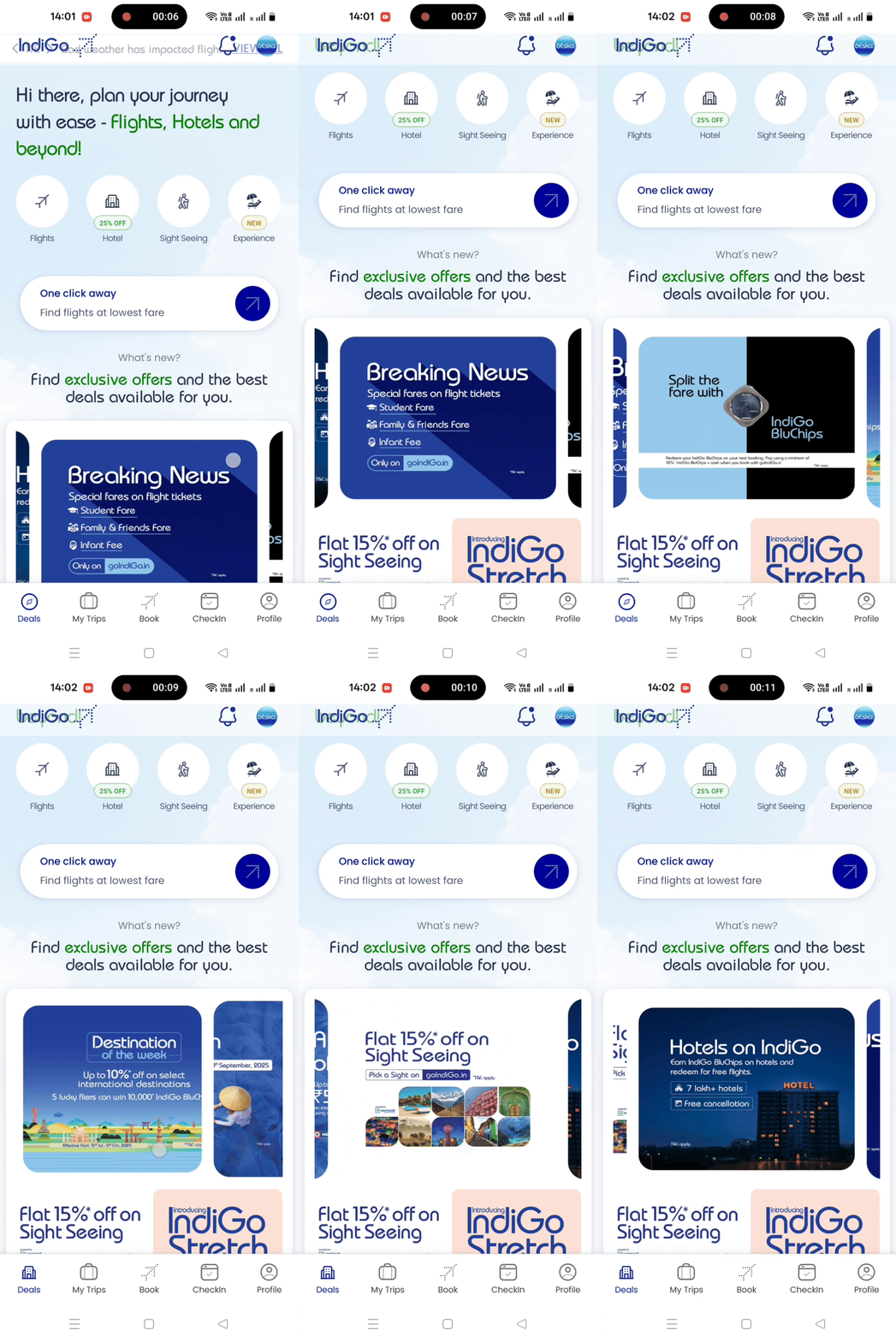
In-app carousels, recommendation widgets, and contextual surfaces that show each user what’s most relevant to them — based on their behavior, not a batch campaign schedule.
5. In-app upsell
The in-app session is when purchase intent is highest. Contextual offers, gamified rewards, and personalized pricing surfaces convert better than any email campaign because they meet the user at the moment of intent.

The new role for off-app channels
This isn’t an argument to stop using push, email, or SMS. It’s an argument to use them like a surgeon — sparingly, with precision, and only when the in-app experience has done its job first.
Off-app channels work best when they:
- Re-engage users who haven’t opened the app in a defined window (not daily blasts)
- Amplify in-app behavior — e.g., notifying a user that their streak is about to break
- Deliver transactional value — order updates, payment confirmations, security alerts
What they shouldn’t do: carry the entire weight of your retention strategy.
Building for the in-app era
The shift from reach-based to experience-based engagement isn’t a prediction — it’s already happening. The infrastructure changes (Gmail AI, Apple Intelligence, notification fatigue) are permanent. The growth teams that recognize this early and invest in in-app capabilities will compound their advantage.
At Plotline, we’ve built the deepest in-app engagement stack in the market — nudges, stories, gamification, widgets, surveys, feature flags — all deployable without app releases. Off-app channels exist in Plotline too, not as the backbone, but as precision tools used alongside a strong in-app foundation.
The apps that win the next five years won’t be the ones with the best push notification strategy. They’ll be the ones where users don’t need to be reminded to come back.
Your app is the channel. Build accordingly.