Your daily active users are climbing. Push notifications are performing. Session frequency hits new highs every week.
But behind the metrics, something’s off. Churn is creeping up. Your best users feel overwhelmed. And that engagement spike? It vanishes the moment you pause your notification campaigns.
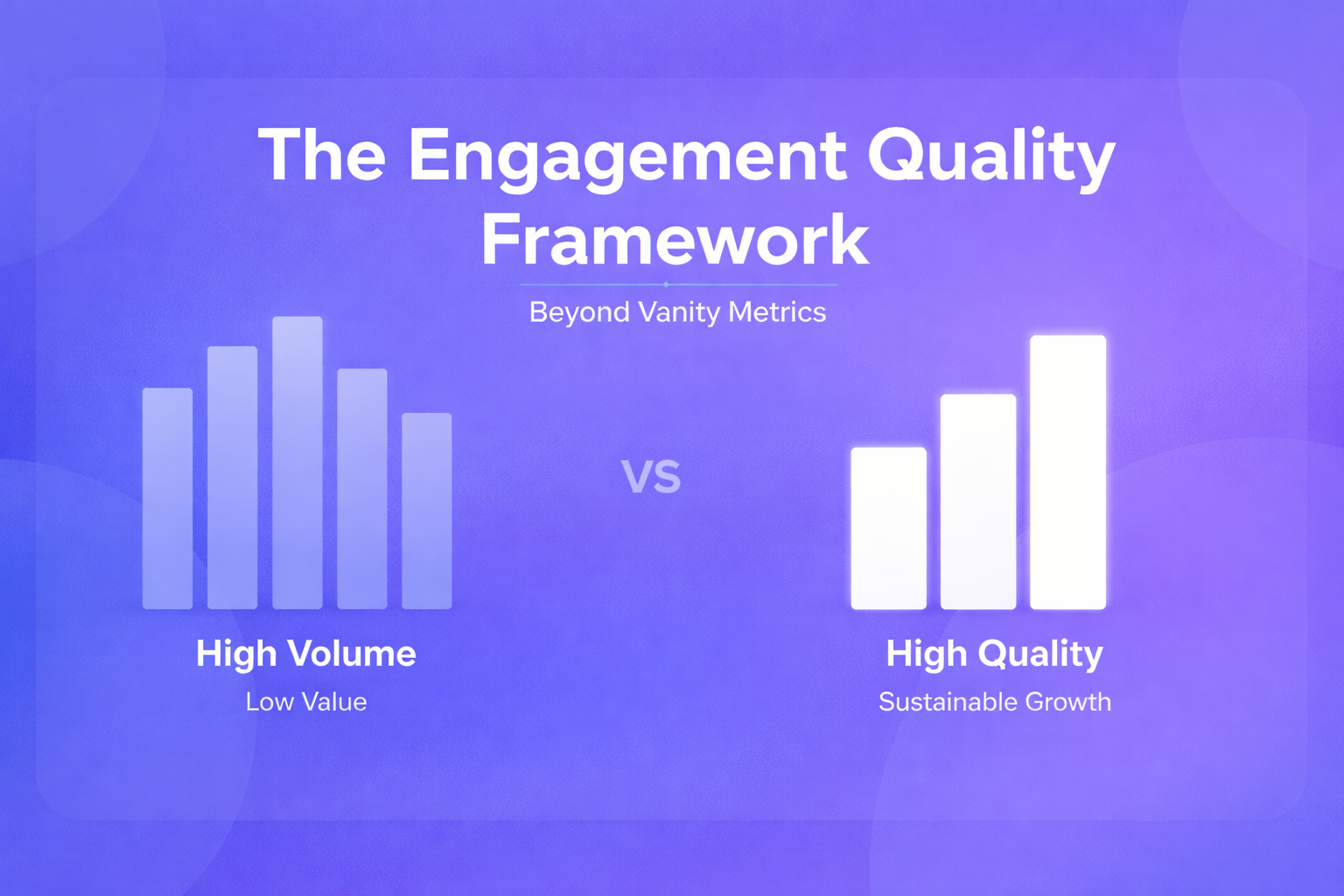
You might be optimizing for engagement volume, not engagement quality. And there’s a massive difference between users who respond to nudges and users who genuinely need your product.
This guide shows you how to measure what actually matters, and build engagement that lasts.
TL;DR
- Engagement quality matters more than volume: High activity doesn’t equal high value if users aren’t accomplishing their goals
- Most products create nudge dependency, not habits: If engagement drops >30% when notifications stop, you have a problem
- Measure intrinsic motivation, not just activity: Track user-initiated sessions, goal completion rates, and behavioral progression
- Trust is your engagement currency: Every notification makes a deposit or withdrawal—manipulative tactics erode long-term retention
- Quality indicators beat vanity metrics: Focus on engagement-satisfaction correlation, feature discovery rates, and value-per-session scores
The engagement paradox: user activity without value
What is engagement quality?
It’s the measure of whether your users are getting real value from their time in your product, not just opening it because you told them to.
Traditional engagement metrics tell you how much users interact with your product. Engagement quality tells you how well those interactions serve them.
Why engagement quality matters?
Research shows that 73% of users who disable notifications never return to daily usage, according to 2024 app engagement studies. When your engagement strategy relies on external triggers rather than intrinsic value, you’re building on borrowed time.
How engagement quality works: the 3-layer framework
Layer 1: Habit formation. What behavior are you training?
Most product and growth teams think they’re training users to “use the app.” That’s not specific enough.
The more important question: Are you training users to open your app when they need it, or when you notify them?
The 4 types of engagement habits
1. Stimulus-Response Habits (Fragile)
- Trigger: External nudge: push notification, email, badge
- Example: Only opening your app after getting notified
- Resilience: Breaks the moment you stop sending notifications
- Red flag: Engagement drops >30% when a campaign ends
2. Problem-Solving Habits (Resilient)
- Trigger: User encounters a specific need or pain point
- Example: Opening a meditation app when stressed, or a budgeting app before making a purchase
- Resilience: Strengthens every time it successfully solves the problem
- Green flag: Users return without prompts 40%+ of the time
3. Routine-Based Habits (Very Resilient)
- Trigger: Time or context cue—morning coffee, commute, bedtime
- Example: Checking your fitness app every morning, reviewing tasks before work
- Resilience: Becomes automatic over time
- Green flag: Users engage at consistent times without reminders
4. Social-Driven Habits (Moderately Resilient)
- Trigger: Other people’s actions—friend posts, team activity
- Example: Opening the app when teammates update a project
- Resilience: Depends on network health and activity
- Green flag: Users explore features you didn’t notify them about
A user who successfully solves their problem 5 times using your app builds a stronger habit than one who opens your app 50 times without clear outcomes.
The nudge dependency test
Run this thought experiment: If you turned off all notifications tomorrow, which users would still engage at the same rate?
If the answer is “very few,” you don’t have engagement: you have notification-driven activity.
Signs of nudge dependency:
- Engagement drops >30% when notifications pause
- Users rarely initiate sessions on their own
- Session depth decreases over time
- Users disable notifications and stop using the app entirely
- Engagement only spikes when you message more
Signs of intrinsic motivation:
- Users return without prompts 40%+ of the time
- Session depth increases in the first 30 days
- Users explore features organically
- Engagement stabilizes at consistent levels
- Users re-enable notifications they previously disabled
Layer 2: Quality vs Volume matrix
What is the engagement quality matrix?
It’s a framework for mapping user actions based on two critical dimensions: value density and intentionality.
Not all engagement is created equal. Here’s how to tell the difference.
Dimension 1: Value Density
How much value does the user extract per minute of engagement?
- Low: Scrolling feeds, checking for updates, routine checks
- High: Completing tasks, achieving goals, learning something new
Dimension 2: Intentionality
Did the user plan this action or respond to a trigger?
- Low: Responding to a notification, impulse behavior
- High: Sought out the app for a specific purpose
The Four Engagement Quadrants:
Flow State (High Value, High Intent)
- Deep engagement with clear goals
- Example: Completing a workout plan, finishing a design project
- What to measure: Time to value, completion rate, satisfaction scores
Power Moments (High Value, Low Intent)
- Serendipitous discoveries that delight
- Example: Personalized insight that surprises the user
- What to measure: Surprise scores, sharing behavior, feature discovery
Habit Building (Low Value, High Intent)
- Quick check-ins as part of routine
- Example: Daily streak check, status updates
- What to measure: Consistency, routine establishment, return frequency
Mindless Activity (Low Value, Low Intent)
- Activity without purpose or outcome
- Example: Infinite scroll, compulsive checking
- What to avoid: Building your success metrics around this quadrant
The goal isn’t to eliminate low-value activities entirely, it’s to ensure they’re not the primary driver of your engagement strategy.
Layer 3: Trust
What is engagement trust?
It’s the user’s confidence that your nudges, notifications, and prompts serve their interests, not just yours.
Every engagement mechanism makes a deposit or withdrawal from your trust bank. And once you’re overdrawn, users check out—permanently.
The Trust Equation
Trust = (Relevance × Timing × Transparency) / (Frequency × Perceived Manipulation)
Trust Builders (Deposits):
- User requested the nudge or guidance
- Perfectly timed to the user’s actual need
- Clear value proposition: “Here’s why we’re showing this”
- Easy to dismiss without consequences
- Helpful personalization, not creepy
- Real urgency, not manufactured
Trust Eroders (Withdrawals):
- Interrupting at inconvenient times
- False urgency: “Limited time!” when it’s not
- Dark patterns that make it hard to say no
- Creepy personalization: “How did you know that?”
- Manipulative language: “Don’t miss out!”
- Over-messaging across multiple channels
The Manipulation Spectrum
Where do your tactics fall?
✓ Supportive:“You mentioned wanting to exercise more. Tomorrow at 7am is clear in your calendar.”
- Aligned with user’s stated goals
- Respects autonomy
- Easy to decline
~ Suggestive:“Users like you often find this feature helpful.”
- Mildly persuasive
- Based on data patterns
- Somewhat presumptive
⚠ Pushy:“Last chance to complete this!”
- Creates false urgency
- Implies negative consequences
- Harder to dismiss
✗ Manipulative:“Your friends are ahead of you.”
- Exploits social pressure
- Manufactures competition
- Guilt-inducing
The best engagement feels like help, not a sales pitch.
How to measure engagement quality: the metrics that actually predict retention
Traditional metrics like DAU/MAU and session frequency are useful, but insufficient. They tell you how much people use your product, not how well it’s serving them.
The 6 quality metrics you should track
1. Goal Completion Rate
- What it measures: % of sessions where users accomplished their stated intent
- Why it matters: Activity without outcomes is vanity
- Target: >60% completion rate
2. Intentional Engagement Rate
- What it measures: % of sessions initiated by users vs notifications
- Why it matters: Shows intrinsic motivation vs dependency
- Target: >50% user-initiated for healthy engagement
3. Behavioral Progression Index
- What it measures: Rate at which users adopt more complex, valuable behaviors
- Why it matters: Sophistication indicates deepening value
- Target: >30% of 90-day users using advanced features
4. Value-Per-Session Score
- What it measures: Weighted score of high-value actions per session
- Why it matters: Efficiency matters more than duration
- Target: Increasing or stable over time
5. Engagement-Satisfaction Correlation
- What it measures: How closely usage correlates with satisfaction scores
- Why it matters: More engagement should mean more happiness
- Target: Correlation coefficient >0.6
6. Notification Independence Ratio
- What it measures: Engagement rate when notifications are off vs on
- Why it matters: Reveals sustainability of your engagement
- Target: <30% drop when notifications pause
Best engagement quality practices for 2026: the implementation guide
Building quality engagement isn’t about removing all nudges, it’s about making every nudge earn its place.
1. Shift from activity to outcomes
Before: “You have 3 new notifications!” After: “Your expense report is ready to review.”
Before: “Don’t break your streak! Open the app now.” After: “You said you wanted to meditate daily. Morning slot at 7am?”
The difference: Specific value vs vague urgency.
2. Build behavorial progression
Map your features by sophistication:
- Beginner (0-30 days): Core functionality, simple workflows
- Intermediate (30-90 days): Customization, efficiency features
- Advanced (90+ days): Power tools, integrations, automation
Design your engagement strategy to naturally progress users through these levels, not keep them stuck in beginner behaviors forever.
3. Make transparency non-negotiable
Add “Why am I seeing this?” to every nudge:
- “Based on your goal to exercise 3x/week”
- “You viewed this 3 times - want to save it?”
- “You haven’t checked your budget in 2 weeks”
Transparency builds trust. Trust builds retention.
4. Give users real control
Implement:
- Notification preference center (not just on/off)
- “Remind me later” options that actually work
- “I’m not interested” feedback that’s respected
- Quiet hours and do-not-disturb modes
- Frequency capping based on user preferences
Users who customize notification settings have 32% higher 90-day retention, according to 2024 engagement studies.
5. Test for nudge dependency
For one user segment, reduce notification frequency by 50% for two weeks.
Results key:
- Engagement drops <20%: Healthy engagement
- Engagement drops 20-40%: Moderate dependency
- Engagement drops >40%: Severe dependency, rebuild needed
Engagement Quality Self-Assessment
Engagement Quality Self-Assessment
Rate your product honestly across these three dimensions
                Habit Formation Health
                0/30 pts


                        >50% of sessions are user-initiated
                        (10 pts)


                        Engagement stabilizes within 8 weeks
                        (10 pts)


                        >60% goal completion rate
                        (10 pts)


                Quality vs Volume Balance
                0/30 pts


                        Top users by frequency = top by satisfaction
                        (10 pts)


                        >30% behavioral progression to advanced features
                        (10 pts)


                        Session quality increasing or stable over time
                        (10 pts)


                Trust & Sustainability
                0/40 pts


                        (10 pts)


                        Engagement-satisfaction correlation >0.6
                        (10 pts)


                        All nudges pass the transparency test
                        (10 pts)


                        Pass nudge dependency test ((10 pts)


            Your Score
            0
            Get started by checking off what applies
Want to build engagement quality like this? Let’s talk about how Plotline can help.
                    [Book a Demo](https://plotline.so/demo)
                    Retake Assessment


            Reset Assessment
What does engagement quality mean for different types of products?
SaaS Products
Quality engagement means users accomplish work faster and return when they need you—not because you reminded them. Focus on problem-solving habits and workflow integration.
Consumer Apps
Quality engagement means users feel better after using your app, not just during. Watch for compulsive checking patterns that indicate anxiety rather than value.
Marketplace Products
Quality engagement means successful transactions and discoveries, not just browsing. Track conversion quality alongside engagement frequency.
Social Products
Quality engagement means meaningful connections and content, not infinite scrolling. Measure relationship depth, not just activity volume.
Start with one metric this week: What percentage of your sessions are user-initiated? That number tells you everything about whether you’re building engagement or dependency.