.png)

TL;DR
- Push notifications still deliver 14x ROI — the highest of any re-engagement channel for ecommerce apps. But the playbook has changed.
- iOS 18+ Apple Intelligence summarizes your push copy into one bland sentence if you don’t write it correctly. iOS 26 extends this to all app categories.
- Cart abandonment pushes remain the highest-ROI use case, recovering 10-15% of abandoned carts when timed correctly (1h, 24h, 72h sequence).
- Personalized push notifications see 259% higher engagement and 4x conversion lift over generic blasts. Go beyond
{first_name}. - The biggest unlock in 2026 is push-to-in-app journey stitching — connecting the tap to a full in-app conversion experience, not just a home screen landing.
- Automated push (just 5% of total sends) drives 28% of all push-attributed orders. Fewer, triggered sends beat volume every time.
Push notifications for ecommerce still deliver the highest ROI of any re-engagement channel. No other channel — not email, not SMS, not WhatsApp — comes close to the combination of immediacy, zero marginal cost, and direct-to-device delivery that push offers.
But in 2026, the playbook has fundamentally changed. iOS Apple Intelligence now summarizes and filters notifications. Android 13+ requires explicit opt-in permission. And user fatigue means that 46% of users opt out if they receive 2-5 irrelevant pushes per week. You cannot just blast promotions anymore.
This is the complete guide to using push notifications for ecommerce apps — the strategies, use cases, templates, and copy frameworks that actually convert in 2026. Whether you are recovering abandoned carts, launching flash sales, or building loyalty loops, every section is designed to be actionable on its own.
1. The 2026 Push Notification Landscape: What Changed and Why It Matters
Push delivers 14x ROI on average — no other mobile channel comes close. The reach is instant, the cost per message is effectively zero, and the real estate (a user’s lock screen) is prime.
But the landscape in 2026 looks nothing like 2023. Three structural shifts have rewritten the rules.
iOS 18+ Apple Intelligence now summarizes notifications. Your carefully crafted push gets compressed into a single AI-generated sentence. iOS 26 reactivates summarization for all app categories — no ecommerce app is exempt.
Android 13+ requires explicit opt-in permission. Push is no longer automatic on Android. Users must actively grant notification permission, making your opt-in flow a critical conversion point.
User fatigue is real and measurable. 46% of users will opt out if they receive 2-5 pushes per week that feel irrelevant. Frequency discipline is not a best practice — it is existential.
The bottom line: send fewer, better notifications — or get summarized into irrelevance.
2. How iOS Notification Summarization Changes Everything for Ecommerce
Apple Intelligence, introduced in iOS 18 and expanded in iOS 26, fundamentally changes how users experience push notifications. Understanding this system is no longer optional for ecommerce marketers.
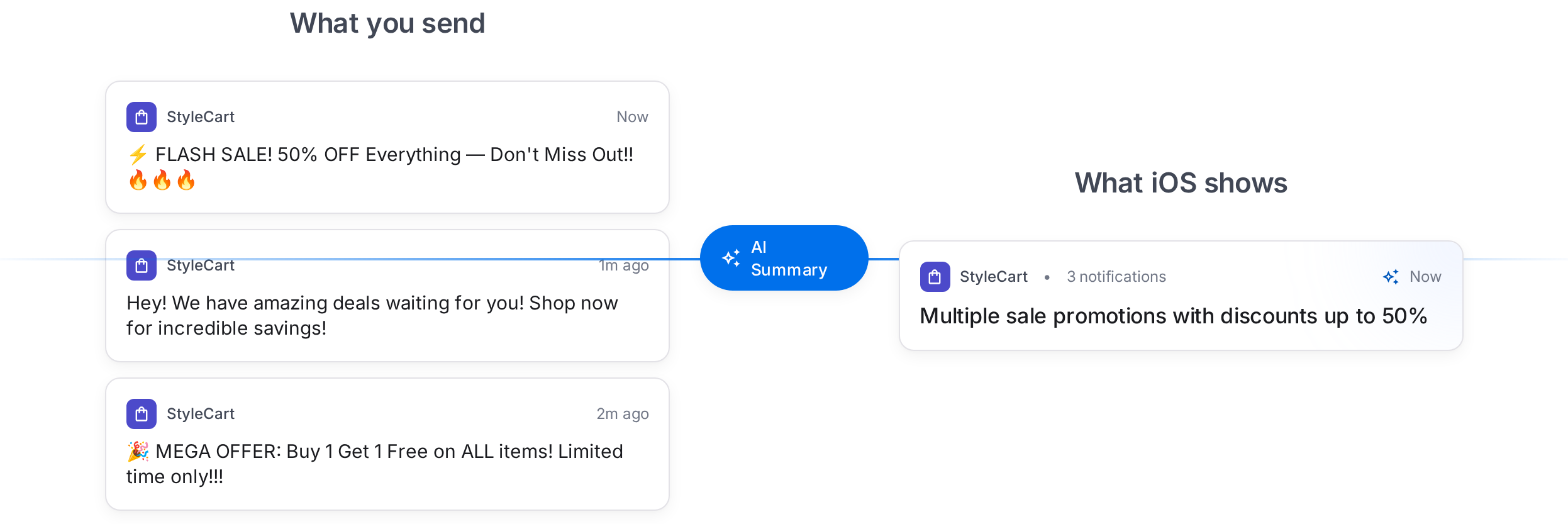
Here is how it works. When a user enables notification summarization (or Apple’s “Reduce Interruptions” focus mode), iOS uses on-device AI to group and summarize notifications from each app. Instead of showing your original copy, the system generates a one-line summary.
The impact is brutal. Your notification that reads “Flash Sale: 60% off our entire Summer Collection with 1,200+ items — ends tonight at midnight!” becomes “StyleCart is having a sale.” All the urgency, specificity, and craft — gone.
Reduce Interruptions mode goes further. It can filter promotional notifications entirely, only surfacing messages the AI deems personally relevant or time-sensitive.
How to write copy that survives summarization. The AI follows predictable patterns you can optimize for.
Front-load the value. The AI disproportionately preserves the first 5-8 words. Put the core offer there, not a greeting or emoji string.
Include specific numbers. Percentages, amounts, hours remaining — quantitative data is treated as informational and tends to survive. “40% off” is more likely to appear than “huge discount.”
Use product names and brand names. Apple Intelligence preserves proper nouns. “UltraRun Pro 90” will appear in a summary. “Your favorite shoes” will not.
Skip emoji-heavy decorative copy. Emojis get stripped by the summarizer, and the sentences they decorated often collapse into meaningless fragments.
The acid test: read only the first 8 words of your notification. Does it still convey the core value? If not, rewrite it.
For a comprehensive deep dive, read our full iOS 18 Apple Intelligence guide.
3. Cart Abandonment Push Notifications: The Highest-ROI Use Case
Cart abandonment is the single most valuable push notification use case in ecommerce. These users have already demonstrated purchase intent — they selected products, added them to the cart, and stopped just short of checkout.
Cart abandonment pushes recover 10-15% of abandoned carts across the industry. Given a ~70% average cart abandonment rate, this represents enormous recoverable revenue.
Timing is everything. Send the first push at 1 hour after abandonment — soon enough that the user remembers, but not intrusive. Send the second at 24 hours with a small incentive. Send the third at 72 hours with a stronger offer or scarcity trigger.
What to include in every cart abandonment push:
- The exact product name and product image (rich push)
- A specific discount or incentive (not “special offer” — the actual percentage or amount)
- An urgency element: stock count (“only 3 left”), time limit, or price expiration
- A one-tap deep link back to checkout with the cart pre-loaded
Example notification copy: “Your UltraRun Pro 90 is selling fast — only 3 left. Complete your order now and save 10%.”
This copy is AI-summarization-proof. The product name (UltraRun Pro 90) is a proper noun preserved by Apple Intelligence. The numbers (3 left, 10%) survive compression. The value proposition is front-loaded.
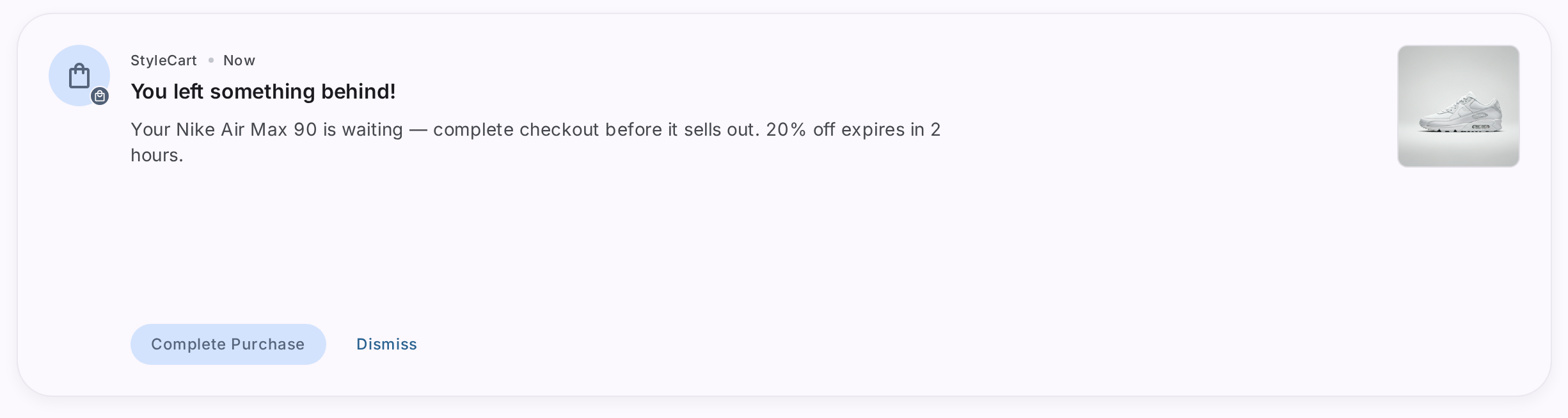
Pro tip: Personalize with the highest-value item in the cart, not just “items in your cart.” If a user has five items but one is a ₹15,000 jacket, lead with the jacket.
4. Flash Sale & Time-Sensitive Promotions
Time-limited promotions are where push notifications truly outperform every other channel. Email gets buried. SMS feels spammy. But a well-timed push with a countdown creates urgency that drives immediate action.
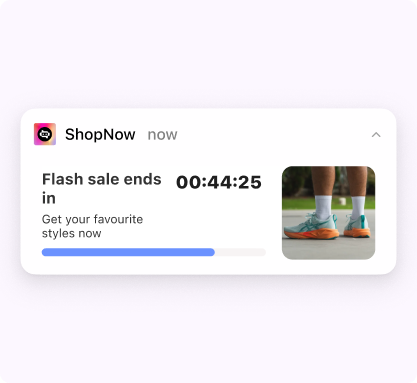
Timer-based push notifications generate 2-3x higher CTR than standard promotional pushes. The countdown element creates a psychological forcing function that flat copy cannot replicate.
The optimal flash sale push sequence:
- 2 hours before: “Heads up: 60% off everything starts at 2 PM. Set your reminder.” Build anticipation.
- At launch: “Live now: 60% off everything for 6 hours. Shop top picks before they sell out.”
- 2 hours before end: “60% off ends in 2 hours. Bestsellers are going fast.” Final urgency nudge.
Rich push with a countdown timer image performs significantly better than text-only. If your push platform supports rich media, always include a timer graphic for flash sales.
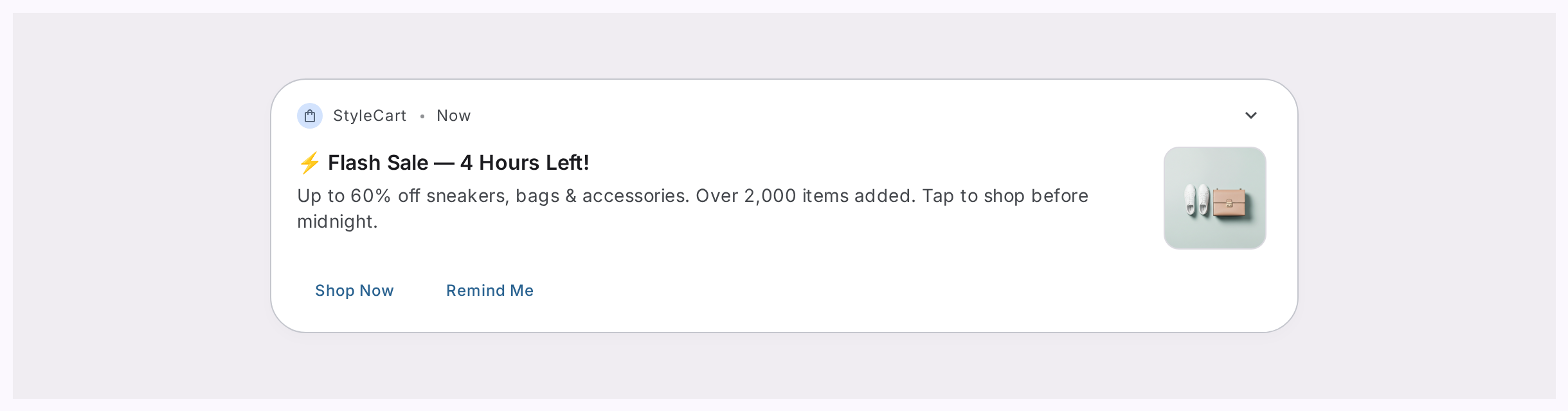
AI-proof tip: “60% off ends in 3 hours” survives summarization far better than “Don’t miss our biggest sale of the year!” The first contains quantitative data and a time constraint. The second is generic hype that collapses when compressed.
For detailed timer and carousel templates, see our guide on interactive push notification templates for ecommerce.
5. Price Drop & Wishlist Alerts
If cart abandonment is the highest-ROI trigger, wishlisted-item price drops are the highest-engagement trigger. A user who wishlisted a product has explicitly told you: “I want this, but not at this price.” When you notify them of a price drop, you are fulfilling a request, not interrupting.
Wishlist price drop alerts see 40-60% higher open rates than generic promotions. These notifications are expected, welcomed, and personally relevant. They feel like a favor, not an ad.
What to include in every price drop notification:
- Old price to new price with percentage savings: “₹24,999 to ₹17,499 (30% off)”
- Product image via rich push — visual recognition is faster than reading
- “Limited stock” indicator if applicable — layer scarcity onto the price trigger
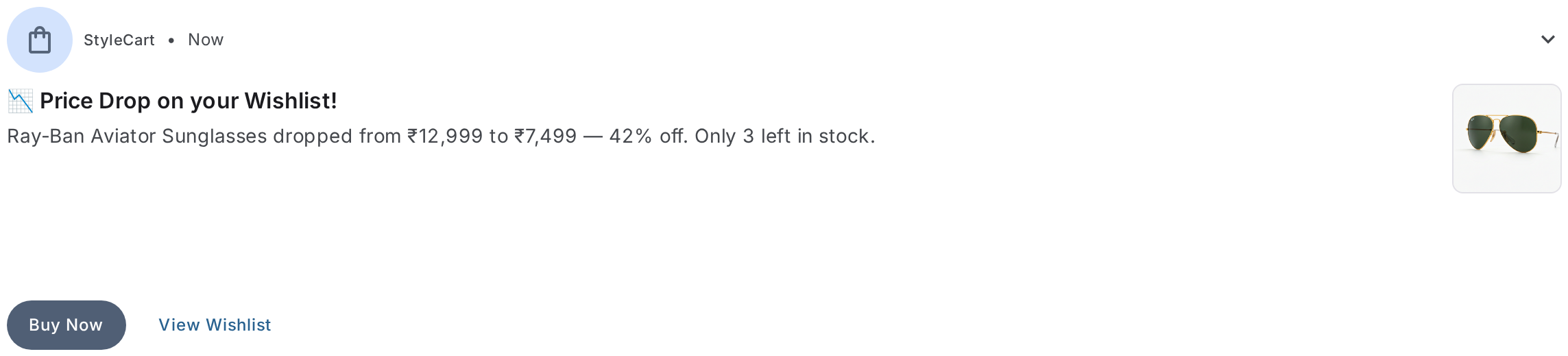
AI-proof tip: “₹24,999 to ₹17,499 (30% off)” is informational and gets preserved by AI summarizers. A generic “Prices dropped on items you love!” gets stripped to almost nothing. Always include the actual numbers.
6. Post-Purchase Cross-Sell & Upsell
The moment after a purchase is the highest-trust moment in the customer relationship. The user just gave you their money. This is your window for cross-sell — but handle it with care.
Timing: 24-48 hours after purchase. Not immediately. Let the customer enjoy the anticipation of their incoming order. Pushing a cross-sell within minutes of checkout feels extractive. Waiting a day or two feels like a helpful suggestion.
Cross-sell matching must be genuinely complementary. Recommend accessories, not random products.
- Bought sneakers? Suggest matching socks, a shoe care kit, or insoles.
- Bought a phone? Suggest a case, screen protector, or wireless charger.
- Bought a dress? Suggest matching jewelry or shoes that complete the outfit.
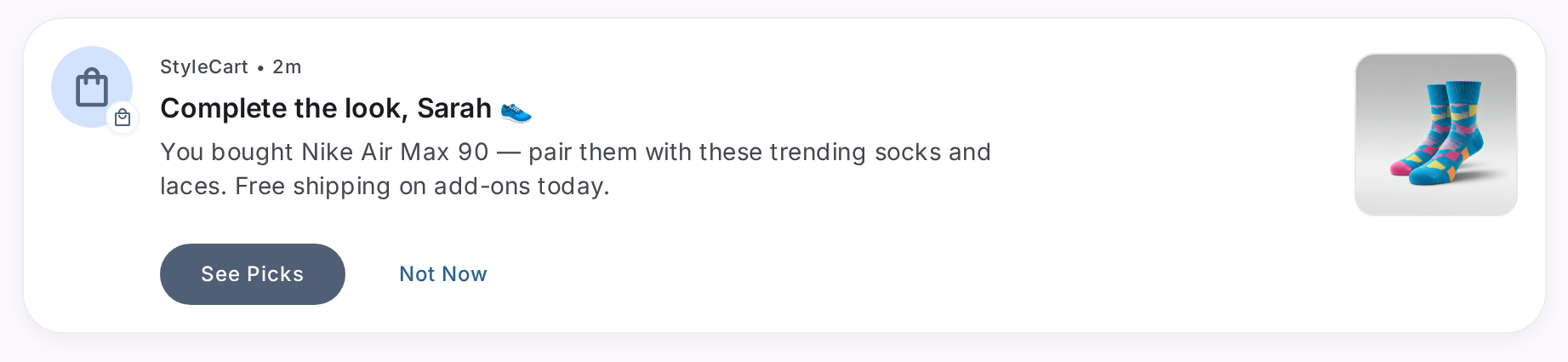
The highest-performing format combines cross-sell with order tracking. “Your order shipped! While you wait, here are accessories trending with your pick.” The tracking update earns the open. The cross-sell earns the revenue.
7. Back-in-Stock Notifications
Users who requested back-in-stock alerts represent the highest purchase intent segment you will ever push to. They found the product, wanted it, discovered it was unavailable, and took the extra step of asking to be notified.
These are not promotional notifications. They are fulfilling a user’s explicit request. You do not need to sell the product — the user already wants it. You need to create urgency around availability.
Layer scarcity with past behavior data. “The StrideMax Boost 23 is back in stock — it sold out last time in 4 hours.” Social proof plus scarcity, and it feels informational, not manipulative.
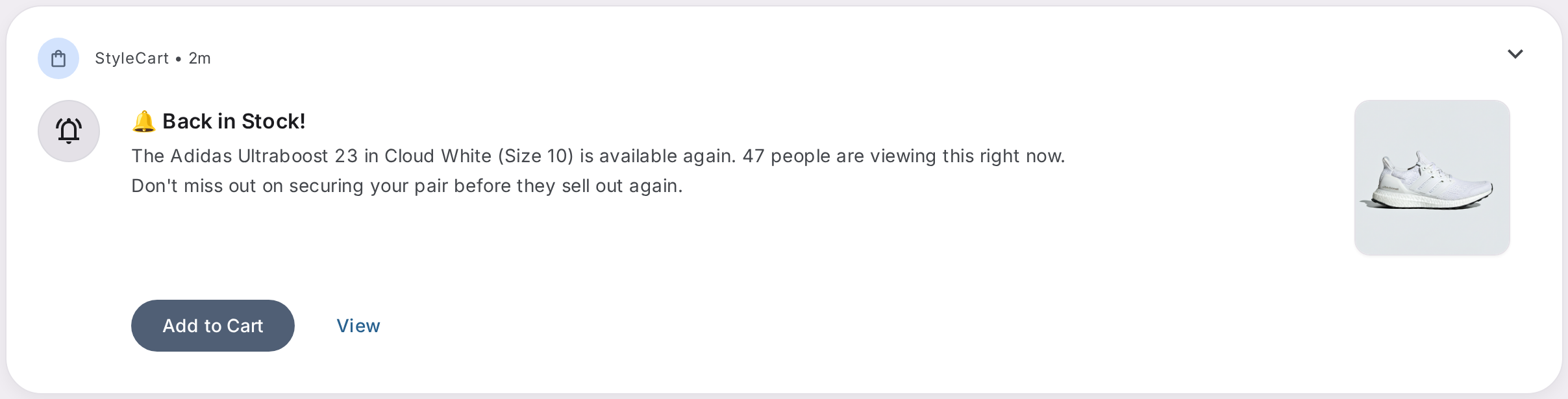
Include two action buttons: “Buy Now” with a deep link to the product page, and “Set Reminder” for users not ready to purchase immediately. Capturing the “not right now” users prevents you from losing them entirely.
8. Loyalty & Rewards Engagement
Push notifications are the ideal channel for loyalty program engagement. Points earned, tier upgrades, rewards expiring — these are personal, quantified, and actionable.
Progress-based notifications drive disproportionate engagement. “You’re 50 points from Gold status” outperforms generic loyalty reminders by 35% in engagement rate. The goal-gradient effect means people work harder the closer they are to a goal. Your push makes that proximity visible.
Personalize with exact point balance and nearest reward. “You have 430 points. Redeem for free shipping (500 pts) or a ₹200 voucher (400 pts).” Give them a clear, specific choice.
Expiring rewards create natural urgency without manufactured pressure. “Your ₹500 reward expires in 48 hours” is urgent but feels like a genuine heads-up, not a marketing tactic.
9. New User Activation & Onboarding
The first 7 days after install determine whether a user becomes a buyer or a churn statistic. Push notifications are your primary lever for guiding new users through that critical window.
The optimal Day 0-7 push sequence:
- Day 0 (Welcome): “Welcome to [Brand]. Here is 15% off your first order — valid for 7 days.”
- Day 1 (Browse prompt): “Trending now: the 10 most-wishlisted items this week.”
- Day 3 (First purchase incentive): “Your 15% welcome discount expires in 4 days. Here are editor’s picks under ₹2,000.”
- Day 5 (Social proof): “2,400 customers bought these this week. See what’s trending.”
- Day 7 (Last-chance offer): “Last day: your 15% welcome offer expires tonight.”
Each notification should feel like a natural next step, not a bombardment. Progressive profiling means each push builds on the previous one — from welcome to browse to consider to convert.
Brands with a structured Day 0-7 push sequence see 2x higher first-purchase conversion compared to ad-hoc pushes.
10. Order Tracking & Delivery Updates
Transactional notifications are the unsung hero of ecommerce push strategy. Not glamorous, but the most opened, most trusted, and most strategically underutilized push type.
Transactional pushes have 80%+ open rates — the highest of any category. Users actively want these updates. This makes transactional pushes your Trojan horse for commercial engagement.
Include subtle cross-sell alongside tracking info. “Your order is out for delivery. Estimated arrival: 3 PM. Customers who bought this also loved [product].” The tracking update earns the open. The cross-sell earns the revenue.
Live tracking push templates — delivery progress bars, ETA updates, driver location — keep users engaged without requiring email checks. Each update reinforces brand trust.
iOS categorization advantage: Transactional pushes are categorized as “Time Sensitive” by iOS. They bypass notification summarization entirely. Your tracking updates reach users uncompressed and unfiltered.
11. Writing Push Copy That Survives AI Summarization
With iOS summarization affecting every ecommerce app, copy strategy is no longer just about persuasion. It is about structural resilience — your copy needs to convey its core value even after AI compression.
Five rules for AI-proof push copy.
Rule 1: Front-load the value proposition in the first 5-8 words. The summarizer preserves the beginning of your message. If your value is buried after a greeting or emoji string, it will be lost.
Rule 2: Include specific numbers. Amounts, percentages, time limits, stock counts — quantitative data survives summarization. “40% off for 3 hours” survives. “Huge savings for a limited time” does not.
Rule 3: Use product names and brand names. AI summarizers preserve proper nouns. “UltraRun Pro 90” appears in the summary. “Your favorite sneakers” gets genericized.
Rule 4: Skip emoji-heavy decorative copy. Emojis are stripped. If your copy relies on them for emphasis, the remaining text collapses into fragments.
Rule 5: Write as if only the first sentence will be shown. In summarization mode, multi-sentence notifications compress to one sentence derived primarily from the first. If your first sentence is a generic hook, that is all the user sees.
Before and after:
The wrong way: “Hey there! We’ve got something AMAZING for you! Don’t miss out on our incredible deals!”
The right way: “UltraRun Pro 90 dropped to ₹8,499 (40% off). 3 left in your size.”
The first version becomes “StyleCart has deals.” The second becomes “UltraRun Pro 90 is ₹8,499, 40% off.” The difference in click-through is enormous.
12. Personalization Beyond {first_name}
Inserting a user’s first name into a push notification is not personalization. It is 2018-era personalization theater. In 2026, users expect notifications that demonstrate genuine understanding of their behavior and context.
Browsing history: “Based on the 3 running shoes you viewed this week, here is one you missed.” This tells the user you are paying attention to what they actually care about.
Cart-specific: Show the exact items in the user’s cart with product images via rich push. A notification showing their specific abandoned products is infinitely more compelling than “You left items in your cart.”
Loyalty tier and point balance: “You’re 50 points from free shipping” is personalized, specific, and actionable.
Purchase pattern predictions: “Your last order of coffee pods was 28 days ago — time for a refill?” This demonstrates understanding of the user’s consumption cycle.
Dynamic liquid tags for real-time attribute insertion. Modern push platforms support dynamic variables that pull real-time data — current point balance, exact cart value, days since last purchase. Use them aggressively.
The data is unambiguous. Personalized push notifications see 259% higher engagement and 4x conversion lift compared to generic batch sends.
13. The Biggest Unlock: Push-to-In-App Journey Stitching
Here is the dirty secret of push notification strategy: most push notifications break the user experience at the most critical moment.
The problem. A user taps your push about a 40% off flash sale. They land on the app’s home screen. The sale banner is somewhere on the page, but they have to scroll to find it. Friction. Confusion. Drop-off. The push got the tap, but the in-app experience failed to convert it.
The solution: push-to-in-app journey stitching. When a user taps a push notification, they should land on a purpose-built in-app experience — a modal, a bottom sheet, a dedicated landing page — that contains exactly the offer they were promised. No friction. No hunting.
Example journey: Cart abandonment push (“Your UltraRun Pro 90 is selling fast”) — user taps — app opens — bottom sheet appears with cart items, discount code pre-applied, and a one-tap checkout button. The push is not a traffic source — it is the first step in a complete conversion funnel.
Backend-triggered real-time journeys via silent push take this further. A backend event (e.g., price drop on a wishlisted item) triggers a silent push that prepares an in-app nudge. When the user next opens the app, they see a contextual modal — no visible push required.
The difference between “push as traffic source” and “push as journey trigger” is the difference between a 2% and a 5%+ conversion rate. Journey stitching is the single biggest unlock for ecommerce apps in 2026.
For implementation details, see our interactive push notification templates guide.
14. Frequency, Timing, and Fatigue Management
More push notifications do not mean more revenue. Beyond a threshold, every additional push actively destroys user trust and drives opt-outs. Frequency management is the discipline that separates high-performing push programs from the ones that slowly bleed subscribers.
2-5 pushes per week is the sweet spot for ecommerce. Below 2, you are leaving revenue on the table. Above 5, unsubscribe rates spike sharply. The exact right number depends on your audience and the relevance of each message — but the 2-5 range is where the data consistently clusters.
AI-optimized send-time personalization delivers 34% higher open rates versus batch sends at a fixed time. Send each notification when each individual user is most likely to engage, not when it is convenient for your marketing team.
Cross-channel frequency capping is non-negotiable. If a user gets a push, an email, and a WhatsApp message about the same flash sale within two hours — that is not multi-channel marketing. That is harassment. Coordinate push, email, SMS, and WhatsApp as one unified experience.
DND windows and timezone-aware delivery are table stakes. Sending a push at 2 AM in the user’s timezone is a guaranteed unsubscribe.
Here is the stat that matters most: automated push (just 5% of total sends) drives 28% of all push-attributed orders. Triggered, behavior-based sends outperform volume-based batch sends by a massive margin. The path to more push revenue is not more pushes — it is smarter triggers.
15. Measuring What Matters: Push Notification KPIs for Ecommerce
Not all push notification metrics are created equal. Some are vanity metrics. Others tell you whether your push program is actually driving revenue.
Opt-in rate benchmark: 68% for ecommerce. Ecommerce apps enjoy higher-than-average opt-in rates because users expect transactional updates like order tracking and delivery notifications. If your opt-in rate is significantly below 68%, your permission prompt strategy needs work. The timing, copy, and context of your opt-in request matter enormously.
CTR benchmarks: 3.78% on Android, 3.05% on iOS for ecommerce. Well-optimized campaigns with personalization and rich media regularly exceed 5-8%.
Revenue per push is the north star metric. Not opens. Not clicks. Actual revenue attributed to each push. This is the only metric that directly connects your push program to business outcomes.
Opt-out rate is your canary in the coal mine. A rising opt-out rate is a content quality signal, not a volume signal. Investigate which campaigns drive opt-outs and fix or kill them.
A/B test templates, not just copy. A carousel template versus a single-image template can outperform copy tweaks by 50% or more. The notification format is at least as impactful as the words inside it.
For proven strategies to increase your opt-in rate, read our guide on how to improve push notification opt-in rates.
Getting Started
The push notification playbook for ecommerce in 2026 comes down to three principles.
Relevance over volume. Triggered, behavior-based notifications (cart abandonment, price drops, back-in-stock, loyalty milestones) outperform batch promotional blasts by every metric. Send fewer, smarter notifications.
AI-proof your copy. Front-load value, use specific numbers and product names, and write as if only the first sentence will be displayed. iOS summarization is not going away — it is expanding.
Stitch the journey. A push notification that lands on a home screen is half a strategy. Push-to-in-app journey stitching — where the tap leads to a contextual, conversion-optimized in-app experience — is the difference between a traffic source and a revenue engine.
If you are looking for a platform that makes all of this implementable without months of engineering work, Plotline offers 20+ rich push notification templates (timer, carousel, grid, milestone), push-to-in-app journey stitching, AI-optimized send-time delivery, and cross-channel orchestration across push, in-app, email, and WhatsApp. Everything in this guide — from cart abandonment sequences to back-in-stock alerts to interactive countdown pushes — can be launched without writing custom code.
Book a demo to see how leading ecommerce apps are implementing these strategies today.