.png)

A user on a stockbroking app finishes their KYC, funds their account, and makes their first trade — all in one session. The next morning, they get a push notification: “Complete your KYC to start trading.”
This isn’t a bug. It’s a symptom. The push tool doesn’t know what the in-app engagement tool knows. They share a user ID, maybe — but not context. Not state. Not timing.
Most consumer apps use 4–7 tools to manage the customer lifecycle — analytics, push, in-app, email, CRM. Each has its own data model, its own event taxonomy, its own version of the user.
The industry calls this “best-of-breed.” In practice, it’s a Frankenstack — technically functional, experientially broken.
Your Stack Creates Gaps, Not Journeys
The gaps between tools are invisible — until a user falls through one.
-
The naming problem. A stockbroking app tracks a purchase as
ad fund successin one platform andpaying successin another. Same event, different names. Can’t build a journey across both. The growth team maintains a spreadsheet mapping event names — and that spreadsheet becomes the most critical infrastructure in the company. -
The timing problem. An iGaming platform’s CRM syncs once per day. A player’s wallet hits zero at noon. The re-engagement campaign fires the next morning. By then, the player has moved on.
-
The attribution problem. A fintech runs a campaign across push and in-app. Push says 10,000 clicks. In-app says 8,000 impressions. Analytics says 2% conversion — but 2% of what? The team reconciles CSVs manually every week.
-
The confusion tax. An iGaming company using three tools was asked which was the source of truth: “It’s confusing — we don’t know which ones are ours.” When teams don’t trust their data, they stop making bold bets.
The visible cost is subscription fees — one company was paying $1,000/month on email alone. The invisible cost is bigger: engineering hours on brittle integrations, campaigns that never launch, decisions made on conflicting dashboards.
Segment Intelligently
You can’t personalize what you can’t see.
Segmentation is the foundation of every journey. In a fragmented stack, that foundation has cracks.
-
A transit app builds cohorts in their analytics tool, exports them, imports into the campaign tool. By the time the import lands, the data is stale. “Which platform should we trust?” comes up every weekly review.
-
A stockbroking app has 400+ events in one platform and a parallel, inconsistent taxonomy in another. A “simple” segment — users who traded but haven’t explored mutual funds — becomes a two-day project involving the data team.
What actually works: A single behavioral graph where every event and attribute lives in one place. Segments update in real time — a cart abandoner enters the segment in seconds, not at the next batch sync. A user who just upgraded is excluded from upgrade campaigns instantly, not in tomorrow’s refresh.
Personalize at Scale
Every channel should know what the other channels know.
Personalization has become a checkbox feature. Every tool claims it. But there’s a difference between inserting a first name and actually knowing what the user needs right now.
-
iGaming: A player’s balance drops below a threshold. The CRM picks it up in its next sync — once a day. The email goes out 18 hours later, with the urgency of a postcard.
-
Stockbroking: A voice agent calls a user who dropped off mid-transaction — but can’t reference what they were doing in the app 5 minutes ago. Says “How can I help you today?” instead of “I noticed you were looking at mutual funds.” The difference? A shared data layer.
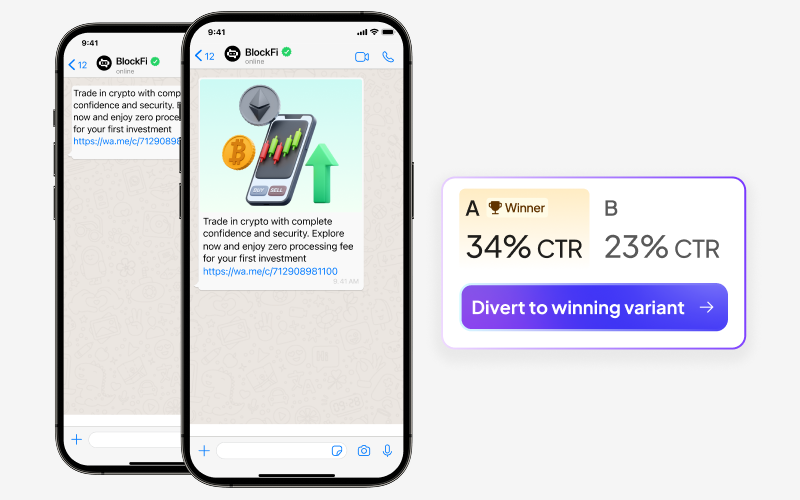
What real personalization looks like: When every channel — push, in-app, email, WhatsApp, voice — reads from the same behavioral data in real time. A push knows you were on checkout. An in-app nudge adapts based on your email engagement. Context travels with the user.
Automate Journeys Across Touchpoints
From disconnected campaigns to orchestrated experiences.
Most “multi-channel journeys” are just separate campaigns triggered at roughly the same time, with no logic connecting them.
-
Transit: The app wants weekday-only push notifications. The tool doesn’t support day-of-week filtering. So the team creates seven duplicate journeys and manually toggles them. The “automation” requires more manual work than the problem.
-
iGaming: In-app gamification runs through one tool, email lifecycle through another. No way to say “if the user won a reward in-app, skip the discount email.” Users get both — eroding margins.
-
Neobanking: 100+ journeys on the CRM, RCS on a separate vendor, in-app on a third. Cross-channel stitching requires coordinating three dashboards. The growth team spends more time managing tools than building experiences.
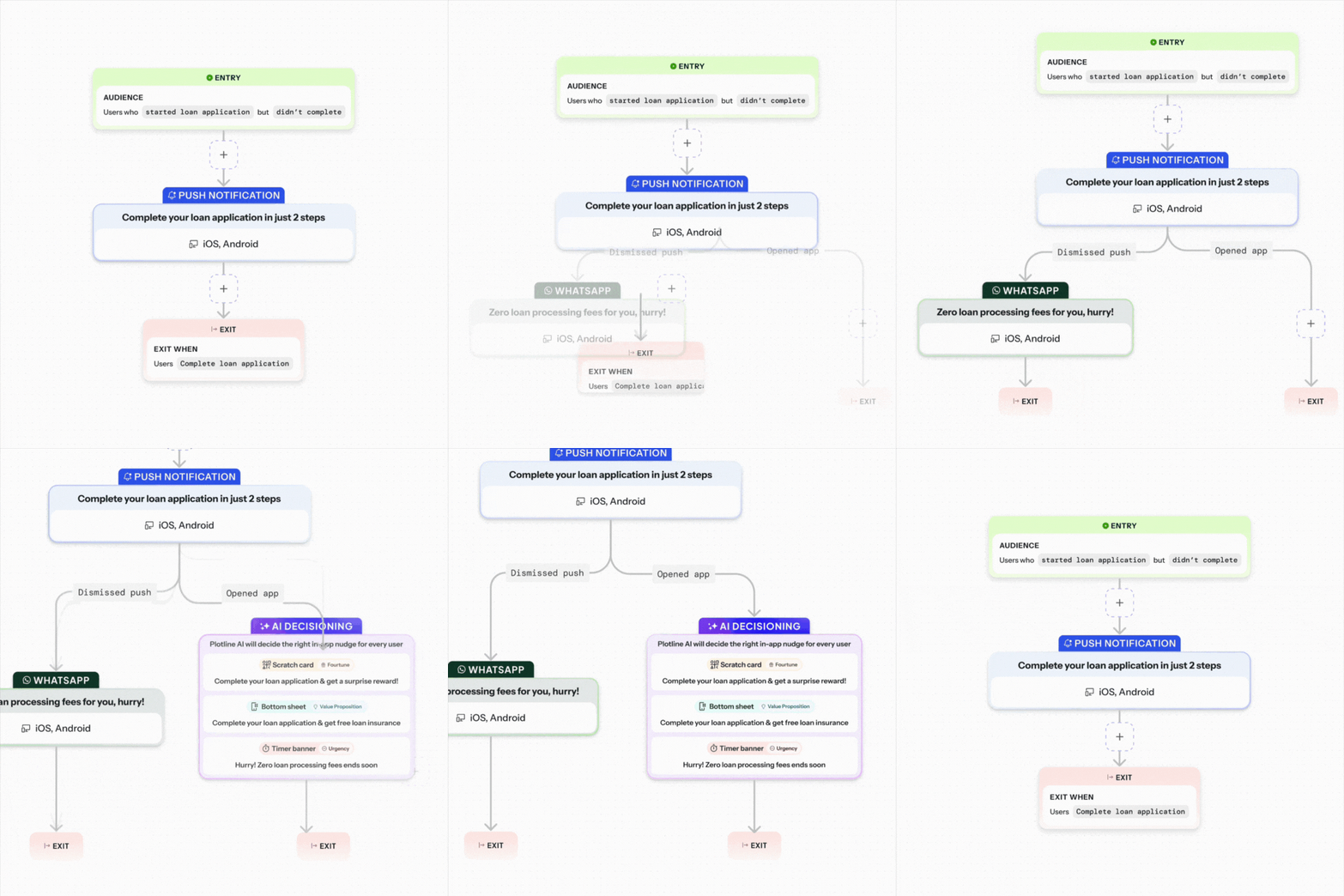
What unified looks like: One journey canvas where push, in-app, email, and WhatsApp are steps in the same flow — with real branching. User opens the push → show an in-app offer. Doesn’t open → WhatsApp 4 hours later. Converts at any step → stop the journey.
.gif)
Adapt Instantly to Customer Behavior
Speed isn’t about sending faster. It’s about knowing faster.
-
iGaming: CRM syncs once per day. Player’s balance hits zero at 6 PM. The re-engagement trigger fires at 5 AM the next day — 17 hours after the moment that mattered. The player has already uninstalled.
-
Neobanking: In-app campaigns take 10–15 seconds to load. On screens where users spend 8–10 seconds, the campaign renders after they’ve scrolled away. Technically delivered. Practically invisible.
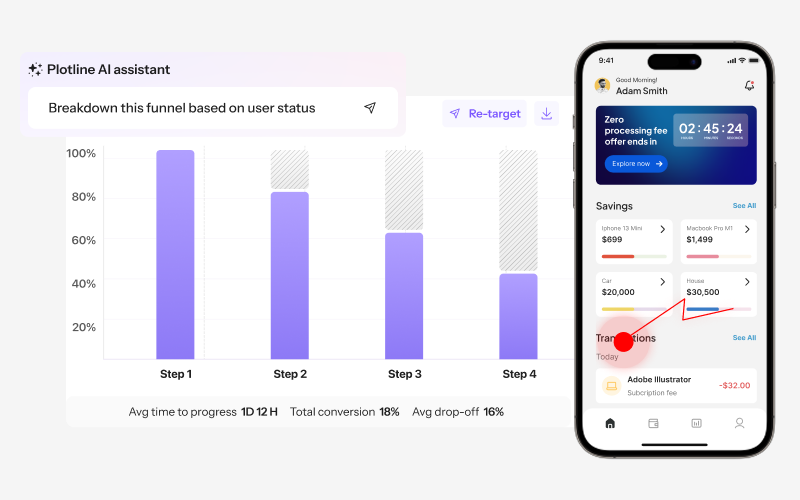
What real-time requires: The platform that captures the event is the same platform that delivers the response. Backend events — payment completed, KYC approved — trigger in-app campaigns within seconds via silent push. No batch sync. No webhook chains.
The Shift: From Tool Sprawl to Platform Intelligence
The pattern is consistent across industries:
-
Stockbroking: 100,000+ users, explicit goal of “zero dependency” on their legacy tool — not because it was bad, but because maintaining parallel systems consumed more engineering time than building product.
-
iGaming: Replaced three tools (CRM, email, reporting). Saved $1,000+/month on email alone — but the real win was a connected journey from first deposit to churn prevention without manual data shuttling.
-
Fintech: Wanted to launch campaigns without engineering tickets and release cycles. The shift was about velocity — moving at the speed of an idea, not a sprint.
The cost of coordination in a multi-tool stack eventually exceeds the cost of switching. When more time is spent integrating tools than using them, the stack isn’t a foundation — it’s an anchor.
Your Journeys Were Never Connected
The problem isn’t strategy. Most teams know exactly what journey they want — the welcome flow, the re-engagement sequence, the cross-sell nudge timed after the first transaction.
The problem is four tools with four data models, four sync schedules, and four dashboards — none designed to work together.
The question isn’t whether your journeys need fixing. It’s whether your stack will ever let you build them.
Plotline unifies in-app, push, email, WhatsApp, and voice on a single platform with a shared data layer — so every channel knows what every other channel knows, in real time.