.png)

TL;DR
- Fintech users abandon 63% of digital applications before completing them — AMP emails bring the form, calculator, or action directly into the inbox to recover these drop-offs
- AMP emails convert at 3x the rate of traditional HTML emails by eliminating the redirect to a landing page
- Key fintech use cases: loan application completion, EMI/SIP calculators, KYC nudges, NPS surveys, gamified promotions (spin-the-wheel, scratch cards), and real-time portfolio updates
- With tools like Plotline, fintech teams can deploy interactive AMP email campaigns from a no-code dashboard — no HTML coding per campaign, with built-in gamification, feedback templates, and cross-channel journey orchestration
Why Fintech Emails Need an Upgrade
The average fintech app sends dozens of transactional and promotional emails every month — payment confirmations, loan offers, KYC reminders, investment updates, policy renewals. Yet most of these emails follow the same pattern: a block of text, a static image, and a “Click here” button that redirects to a landing page or the app.
The problem? Every redirect is a drop-off point.
A user who receives a loan pre-approval email has to click a CTA, wait for a page to load, log in, navigate to the application form, and then start filling in details. By the time they reach the form, you’ve lost 60-70% of them. For fintech apps — where the product is often complex and the conversion funnel has multiple steps — this friction is devastating.
Digital account opening abandonment rates have climbed from 40% in 2016 to 63% in 2020, according to a Signicat study — almost two in three potential customers abandon the process before completing it.
AMP emails solve this by bringing the action into the inbox. Instead of asking users to go somewhere else, you let them apply, calculate, rate, and convert — right where they are.
What Are AMP Emails?
AMP (Accelerated Mobile Pages) for Email is a framework that enables interactive, app-like experiences directly inside the email client. Instead of static HTML that can only display content and link out, AMP emails let recipients:
- Fill out forms — loan applications, KYC details, feedback surveys — without leaving the inbox
- Use calculators — EMI, SIP, insurance premium calculators with real-time results
- Browse products — swipeable carousels of credit cards, investment plans, or insurance policies
- Play games — spin-the-wheel, scratch cards, and quizzes with instant rewards
- See live data — real-time portfolio values, stock prices, or account balances that update when the email is opened
- Submit ratings — NPS scores, service ratings, and feedback with one tap
AMP emails are supported by Gmail, Yahoo Mail, and Mail.ru — covering over 1.8 billion email accounts globally. For unsupported clients like Apple Mail and Outlook, AMP emails automatically fall back to a standard HTML version.
8 AMP Email Use Cases for Fintech Apps
1. Loan and Credit Application Completion
The most impactful AMP use case for lending apps is embedding the application form directly in the email. When a user is pre-approved for a personal loan or credit card, the email doesn’t just tell them — it lets them complete the application right there.
How it works:
- The email contains an embedded multi-field form (name, income, employment type, desired loan amount)
- The user fills in the details and submits — all within the inbox
- The submission triggers a backend workflow to process the application and move the user to the next step (document upload, e-sign, or disbursal)
Why it matters for fintech: Loan applications are high-intent but high-friction. The user has already expressed interest (they opened the email), but the redirect to a landing page kills momentum. AMP eliminates that redirect entirely.
Findomestic, a European consumer credit company, A/B tested AMP emails against standard HTML for loan product promotions. The result: a 128% increase in open rates and a 133% increase in click-through rates. Users opened the dynamic email multiple times to interact with the embedded calculator.
2. EMI and SIP Calculators
Financial calculators are one of the most engaging AMP email components for fintech. Instead of linking to a calculator page on your website, embed the calculator directly in the email.
Use cases:
- EMI calculator: User enters loan amount, tenure, and interest rate — sees monthly EMI instantly inside the email
- SIP calculator: User inputs monthly investment amount and expected return rate — sees projected corpus
- Insurance premium calculator: User selects coverage amount and term — sees premium quotes in real time
- Credit card reward calculator: User enters monthly spend — sees estimated reward points and cashback
Why it matters: Calculators create a “playground” effect — users interact with different inputs, see personalized results, and self-qualify for the product. This interaction builds intent. When the user is ready, the CTA takes them directly to the application with pre-filled parameters.
3. KYC Completion Nudges
KYC drop-off is one of the biggest conversion killers in fintech onboarding. Users start the process, get distracted, and never come back. AMP emails can nudge them to complete pending steps without app-switching.
How it works:
- The email shows the user’s KYC progress (e.g., “2 of 4 steps completed”)
- Pending fields (PAN number, address proof type, date of birth) are embedded as form inputs
- The user completes the missing information directly in the email
- For document uploads, the CTA deep-links to the specific upload screen in the app — skipping the homepage and navigation
Why it matters: Traditional KYC reminder emails say “Complete your KYC — click here.” The user clicks, opens the app, navigates to KYC, and has to figure out where they left off. AMP emails skip all of that by showing exactly what’s missing and letting the user fill it in right there.
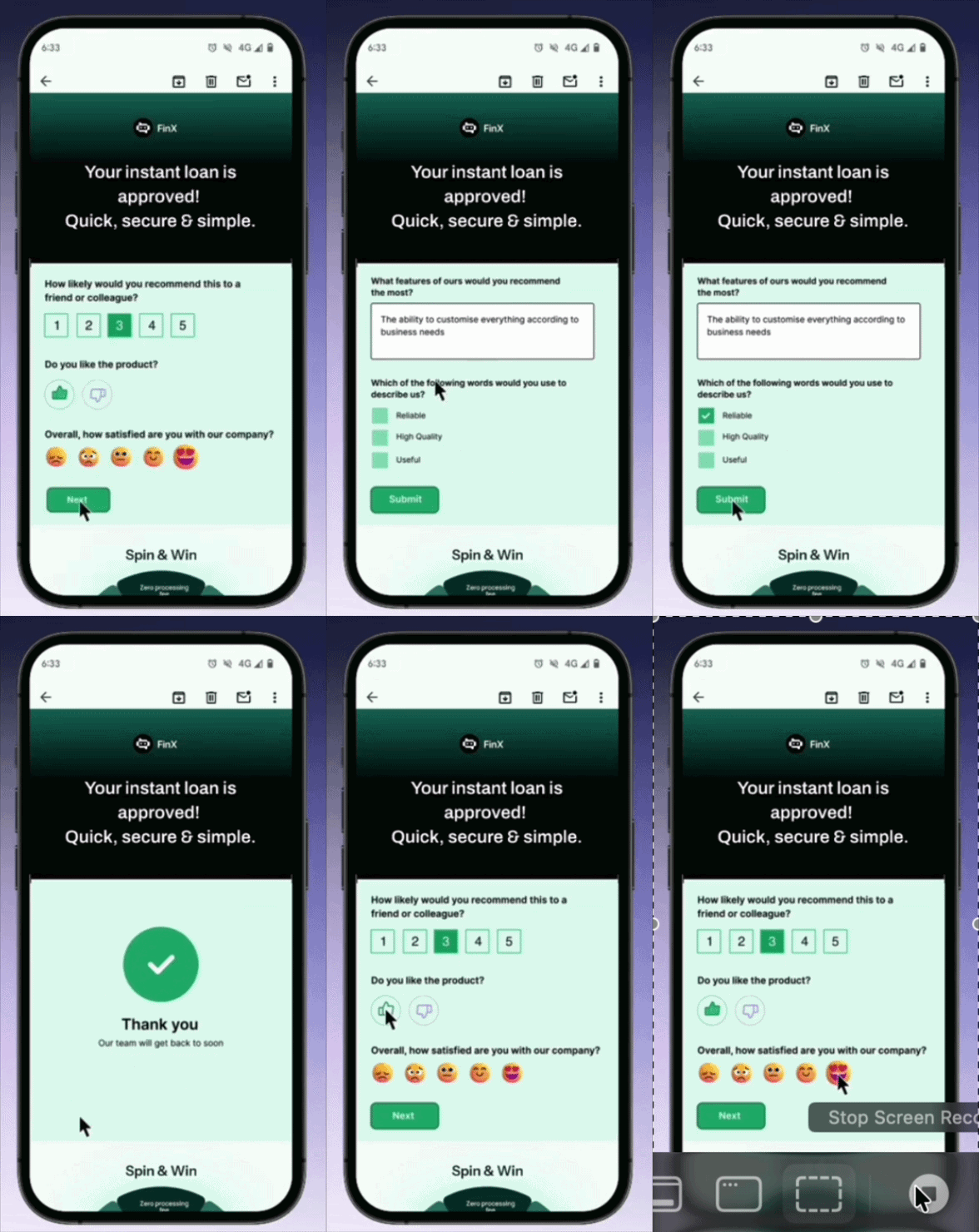
4. NPS Surveys and Customer Feedback
Fintech apps need feedback at critical moments — after a loan disbursal, post-claims settlement, after a customer support interaction, or following a first investment. Traditional survey emails have completion rates of 5-10%. AMP emails push this to 25-40%.
How it works:
- NPS survey: “On a scale of 0-10, how likely are you to recommend us?” — the user taps a number directly in the email
- CSAT rating: Star-based rating widget for a recent transaction or support interaction
- Multi-question feedback: Conditional follow-up questions based on the initial rating (e.g., if rating < 7, ask “What could we improve?”)
- Open-ended feedback: Text input fields for detailed comments, submitted without leaving the inbox
Why it matters: Razorpay, one of India’s largest payment gateways, switched from redirect-based surveys to AMP email surveys. The result: a 257% increase in survey responses. The zero-redirect experience meant merchants completed the survey in the same session as reading the email.
For fintech apps, this feedback loop is critical for regulatory compliance (many regulators require documented customer satisfaction metrics), product improvement, and churn prevention.
5. Gamified Promotions — Spin the Wheel and Scratch Cards
Gamification in fintech emails might sound counterintuitive — but it’s one of the highest-performing engagement tactics when used strategically. The key is tying the game to a relevant financial reward.
Spin the Wheel:
- “Spin to win your reward on your next mutual fund SIP!” — wheel options include cashback percentages, fee waivers, or bonus reward points
- Each spin reveals a personalized reward with configurable probability and per-user limits
- The reward is tied to an action — “Get 2% extra cashback on your next credit card payment”
Scratch Cards:
- “Scratch to reveal your personal loan interest rate” — the scratch card reveals a pre-qualified rate
- Post-transaction scratch cards — “You just completed a ₹10,000 payment. Scratch to see your reward!”
- Coupon-based scratch cards with unique codes per user — the game triggers until codes are exhausted
Why it matters for fintech: Gamification creates urgency and emotional engagement that flat promotional emails cannot. A user who receives “You’re pre-approved for a personal loan at 10.5%” might ignore it. The same user who receives “Scratch to reveal your exclusive interest rate” is far more likely to engage — because curiosity is a powerful motivator.
When the reward is tied to a financial product action (apply for a loan, complete a SIP, upgrade your card), gamification drives both engagement and downstream conversion.
6. Interactive Product Comparisons
Fintech products are complex — users need to compare credit cards, loan terms, insurance plans, or investment options before making a decision. AMP emails can embed interactive comparison widgets directly in the inbox.
Use cases:
- Credit card comparison carousel: Swipeable cards showing different card tiers — features, annual fees, reward rates, and “Apply Now” CTAs per card
- Loan offer comparison: Side-by-side comparison of pre-approved loan offers with different tenures and rates
- Insurance plan comparison: Toggle between different coverage levels and see how premium changes
- Investment product carousel: Browse mutual funds, fixed deposits, or savings plans with returns data
Why it matters: When a user receives an email with multiple financial products, a standard email forces them to click through to a comparison page. AMP brings the comparison into the inbox — the user swipes, compares, and clicks “Apply” on the product that fits, all in one flow.
7. Real-Time Portfolio and Account Updates
AMP emails can pull live data at the moment the email is opened — making them perfect for financial summaries that need to be current.
Use cases:
- Portfolio summary: Current portfolio value, daily/weekly change, top performers and underperformers — updated in real time when the email is opened
- Account balance snapshot: Current balance, recent transactions, and spending category breakdown
- Stock watchlist updates: Live prices for stocks on the user’s watchlist
- SIP performance update: Current value vs. invested amount, with XIRR returns calculated dynamically
Why it matters: Static portfolio update emails are stale by the time the user reads them — stock prices change, NAVs update, and balances shift. AMP emails show the current state, making the email genuinely useful rather than just a notification.
8. Payment Reminders with In-Email Actions
Payment reminders are high-frequency fintech emails — EMI due dates, SIP payment confirmations, insurance premium deadlines, credit card bills. AMP makes them actionable.
How it works:
- The email shows the payment amount, due date, and account details
- A “Pay Now” button deep-links directly to the payment screen in the app with the amount pre-filled
- For auto-pay setup, the email includes a toggle to enable automatic payments for future cycles
- Post-payment, the email dynamically updates to show “Paid ✓” status when reopened
Why it matters: Payment reminder emails have one job: get the user to pay. Every click between the email and the payment screen is a drop-off risk. AMP emails reduce this to a single tap — or, with in-email payment integrations, eliminate the redirect entirely.
AMP Emails + In-App Engagement: The Fintech Playbook
The real power of AMP emails for fintech isn’t just the email itself — it’s how the email connects to the in-app experience. When AMP emails are part of a cross-channel journey, the conversion impact compounds.
Journey 1: Loan Application Recovery
Day 1 — AMP email: User receives a pre-approval email with an embedded loan application form. They start filling it in but don’t submit.
Day 2 — Push notification: “Your ₹5L pre-approved loan is waiting. Complete your application in 2 minutes.”
Day 2 — In-app nudge: When the user opens the app, a bottom sheet appears showing their incomplete application with a “Resume” CTA.
Day 3 — Follow-up AMP email: A second email with the form pre-filled with the data they entered on Day 1. One-tap submission.
Journey 2: Gamified Engagement Campaign
Day 1 — AMP email with Spin the Wheel: “Spin to win up to 3% extra returns on your next SIP!” User spins and wins 1.5% bonus.
Day 1 — In-app tooltip: When the user opens the app, a tooltip highlights the SIP section: “Your 1.5% bonus is waiting — start a new SIP to claim it.”
Day 3 — Push notification: “Your 1.5% SIP bonus expires in 48 hours.”
Day 5 — AMP email with Scratch Card: “Didn’t claim your reward? Scratch to reveal a new offer.” A fresh reward keeps the engagement loop alive.
Journey 3: Post-Transaction Feedback + Cross-Sell
Day 0 — Transaction confirmation (standard email): “Your ₹25,000 investment in XYZ Mutual Fund is confirmed.”
Day 1 — AMP email with NPS survey: “How was your investment experience? Rate us.” The user taps 8/10.
Day 1 — Conditional follow-up: Since the rating is 8+, the email dynamically shows a cross-sell carousel: “Based on your investment, you might also like these funds.”
Day 3 — In-app widget: A persistent banner on the home screen shows personalized fund recommendations based on the recent investment.
Best Practices for AMP Emails in Fintech
1. Start with High-Impact, Low-Complexity Templates
Don’t build an in-email loan application as your first AMP campaign. Start with templates that deliver quick wins:
- NPS/rating surveys — single interaction, instant results, measurable lift
- Scratch card promotions — high engagement, simple to configure
- Product carousels — visually impactful, proven to increase click-through rates
Then scale to more complex use cases like multi-field forms, calculators, and conditional flows.
2. Always Build an HTML Fallback
AMP emails are supported by Gmail, Yahoo Mail, and Mail.ru — but not by Apple Mail, Outlook, or most enterprise email clients. Every AMP email must include a standard HTML version. For fintech apps with enterprise or B2B users who may use Outlook, the fallback needs to be compelling on its own — not a degraded afterthought.
3. Personalize with User Attributes
Use dynamic data binding to pull user-specific information into the email at open time:
- Pre-approved loan amounts and interest rates
- Current portfolio value and SIP performance
- Pending KYC steps specific to the user
- Reward points balance and expiry dates
Emails with personalized subject lines are 26% more likely to be opened — and when combined with AMP interactivity, the engagement lift compounds.
4. Tie Gamification to Financial Actions
Fintech gamification works best when the reward is tied to a product action, not just a generic discount:
- “Spin to reveal your personal loan rate” → drives loan applications
- “Scratch to win cashback on your next SIP” → drives investment completions
- “Complete the quiz to unlock a fee waiver” → drives credit card activations
The game creates engagement; the financial reward creates conversion.
5. Respect Regulatory Constraints
Fintech emails operate under dual regulation — financial compliance (RBI, SEBI, IRDAI in India; FCA, SEC globally) and data protection (GDPR, DPDP Act). Key considerations:
- Don’t collect sensitive data (Aadhaar numbers, full bank account details) via in-email forms — deep-link to the app for these
- Include mandatory disclosures and disclaimers in both the AMP and HTML fallback versions
- Ensure AMP form submissions go through encrypted, compliant data pipelines
- Maintain clear opt-out mechanisms in every email
6. Measure Beyond Opens and Clicks
Standard email analytics don’t capture the full picture for AMP emails. Track in-email interactions as distinct events:
- Calculator interactions (how many users played with the EMI calculator?)
- Form submissions (what’s the in-email completion rate vs. landing page?)
- Game plays (spin-the-wheel engagement rate, reward claim rate)
- Rating submissions (NPS distribution, CSAT scores by segment)
- Carousel swipes (which product card gets the most engagement?)
This data tells you not just whether the email was opened, but how users interacted with it — and where they dropped off within the email itself.
7. A/B Test AMP vs. HTML
Run controlled A/B tests between AMP and standard HTML versions of the same campaign. Don’t just compare open and click rates — measure downstream fintech metrics:
- Loan application completion rate
- SIP start rate
- KYC completion rate
- NPS response rate
- Reward claim-to-conversion ratio
Findomestic’s A/B test showed a 128% increase in open rates and 133% increase in click rates for AMP vs. standard HTML. But the most interesting finding was that users opened the AMP email multiple times to interact with the calculator — something that never happens with static HTML.
How Plotline Makes AMP Emails Easy for Fintech
Building AMP emails from scratch requires writing AMP HTML markup — a separate skillset from standard email development. For fintech teams that want to move fast without depending on engineering for every campaign, Plotline offers a no-code approach.
No-code template editor: Pick from a library of AMP email templates — carousels, gamification, rating widgets, feedback forms, and rich media layouts — customize the design, add your content and CTAs, set your audience, and publish. No AMP markup knowledge required.
Built-in gamification: Spin-the-wheel, scratch cards, and quiz templates with configurable rewards, probability settings, per-user limits, and reward expiry — all deployable inside the email from the dashboard.
Feedback and NPS templates: Pre-built survey templates with star ratings, NPS scales, multi-question flows, and conditional follow-ups. Collect feedback directly in the inbox without redirect.
Dynamic personalization: Use Liquid Tags to personalize every email with user-specific content — pre-approved amounts, portfolio values, pending steps, reward balances.
Cross-channel journeys: Connect AMP emails with push notifications, in-app nudges, bottom sheets, tooltips, and WhatsApp messages. Build multi-day, multi-channel journeys where the AMP email is the entry point and in-app experiences complete the conversion.
Built-in analytics and A/B testing: Track every in-email interaction alongside standard email metrics. Run A/B tests between AMP and HTML, between different templates, or between different reward configurations.
Automatic HTML fallback: Every AMP email automatically includes an HTML fallback version, ensuring your message reaches users on all email clients — including Outlook and Apple Mail.
The Bottom Line
Fintech emails have traditionally been functional but forgettable — payment confirmations, statement notifications, and promotional blasts that look the same as everyone else’s. AMP emails change this by turning the inbox into an interactive channel where users can apply, calculate, compare, play, rate, and convert — without ever opening a browser.
The data is clear: AMP emails convert at 3x the rate of standard HTML, drive 257% more survey responses, and create engagement loops that keep users coming back. For fintech apps competing for attention in crowded inboxes, AMP isn’t a nice-to-have — it’s a competitive advantage.
The brands that adopt AMP emails early are building a moat: higher conversion rates, better feedback loops, deeper engagement, and multi-channel journeys that connect the inbox to the app seamlessly.
Ready to bring interactive emails to your fintech app? Book a demo with Plotline to see AMP email templates in action.


